Argentan
Sint-Niklaas
Schongau
Lucca
Colmar
|
|
|
|
|
|
| Argentan |
Sint-Niklaas |
Schongau |
Lucca |
Colmar |
PAST EVENTS 2024 |
|||||||||||||||||||||||||||||||||||||||||||||||||||||||||||||||||||||||||
|
Go to 2023 Events. See also the list of all Events since 2007, Future Events and the Newsletters. Most images can be enlarged by clicking on them.
|
|||||||||||||||||||||||||||||||||||||||||||||||||||||||||||||||||||||||||
Christmas LunchSunday 22 December 2024 - at Hilton Garden Inn, Marcham Road, OX14 1TZ
Vegetable terrine, cod and tart would like to meet salmon mousse, turkey and trimmings followed by pudding with custard. Oh, and coffee and a mince pie to top it all off. What happens when they meet? “I have a secret, a fear of speed bumps, but I’m slowly getting over it.” To which the other replies, “We’re just a couple of plates, but dinner is on me tonight.” It wasn’t dinner, but the Christmas lunch at the Hilton Garden Inn, Abingdon, where these exchanges may have taken place. Substitute menu choices for the opening lines and Chinese crackers for the jokes, and you have a most enjoyable Christmas lunch for a group of stalwart “Twin Towners.” It may be cold and sometimes hard in a topsy turvy world, but 35 of us enjoyed excellent company, meeting up with old friends, some very brightly coloured clothes, a glass or two of wine and a very pleasant lunch – all in the warm, away from the biting wind. Father Christmas, himself (or herself?) even appeared briefly. Our thanks to Peter Dodd for organising the event and for the staff of the hotel for providing a pleasing lunch. I hope to see you next year - i.e. in about two weeks’ time. Happy New Year. Neil Hancox Church Twinning Quiz EveningSaturday 23 November 2024 - at the Conduit Centre, Trinity Church, Conduit Road, OX14 1DB
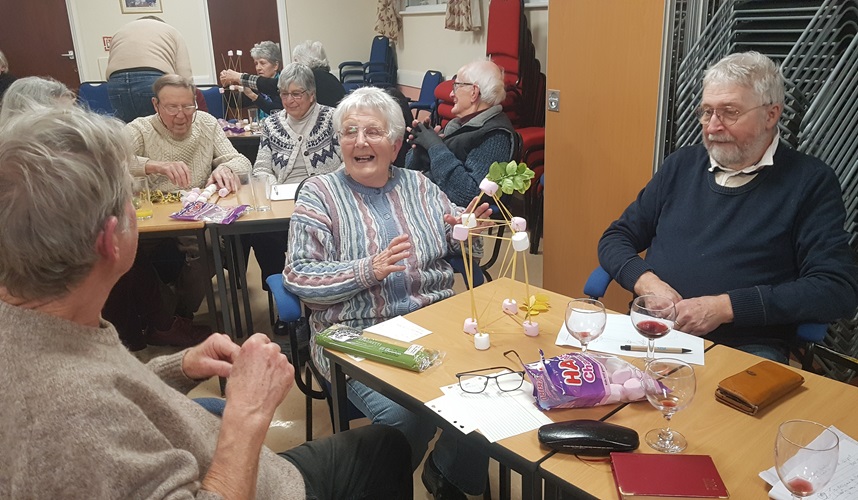
(photos Alastair Fear) On Saturday 23rd November, Abingdon’s Church Twinning group held a very successful quiz evening in the Conduit Centre attached to Trinity Church. A packed hall of enthusiastic participants helped raise funds to support hosting visitors from our twin towns in the coming year. A substantial bread and cheeses supper contributed to the enjoyment of the evening. The quiz master was Richard Kirby, who was known to some as the enthusiastic host of similar quiz events he organises on behalf of Abingdon Rotary Club. Equipped with custom answer books, ten teams of six did battle with Richard’s intriguing questions. In the event, the outcome was extremely close, with only 0.3 of a point separating the two top teams! Evening Meeting - Talk on Puccini and LuccaThursday 21 November 2024 - at Preston Road Community Centre Giacomo Puccini, 1858-1924, a talk by Phil Addison, to ADTTS
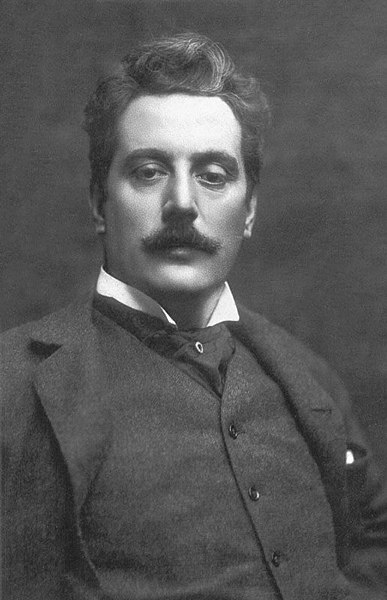
In his own words Puccini described himself as a ‘mighty hunter of wildfowl, operatic librettos and attractive women.’ He was a very successful operatic composer, worth (in today’s value), 200M euros at his death, but with a flawed personal life. He was one of eight surviving children whose father was one of a long line of cathedral organists at San Martino cathedral in Lucca. The only subject that interested him at school was music, plus extracurricular activities such as smoking cigars, poaching game and gypsy girls. By 17 he was playing the piano in various bars in Lucca, teaching music and once stole two organ pipes from a convent where he played the organ, to fund his smoking. Puccini’s first introduction to opera was aged 18. He walked to Pisa to see Verdi’s Aida and was immediately captivated. He submitted a composition of his own, a cantata to celebrate Italy’s newfound nationhood, to a Lucca City Exhibition, but it was returned with the comment that ‘his handwriting needed improvement.’ He turned down Lucca’s offer to become cathedral organist and later the director of Lucca’s music school. Instead, he won a place at the Milan Conservatoire where his only interest was studying composing. He even wrote his own obituary comparing himself to Boccherini, also from Lucca, and with a power challenging that of Wagner. He was not modest! Money was tight but he managed to go to La Scala with Mascagni (Cavalieri Rusticana). His first opera, Le Villi, with a Germanic style, was reasonably successful and attracted the attention of the musical publisher Ricordi, who published his work for many years. The opera was premiered in the UK in Manchester in 1897, in a translation by Percy Pinkerton (c.f. the anti-hero of Madame Butterfly). An old friend told him at the time to steer clear of women, not to fall in love and not to marry. All to no avail as he started an affair with Elvira, a married woman with two children, whose husband, an old school friend, was a serial womaniser. When it was obvious that they were going to have a child (b 1886) the citizens of Lucca were scandalised. They eventually forgave him but not Elvira. To avoid scandal, the couple initially lived apart, but in 1891 moved to Torre Del Largo, a reasonably close town on Lake Massacuiccoli, where they remained until three years before Puccini’s death. He composed all his operas, apart from Turandot, at Torre Del Largo – Manon Lescaut, 1892, La bohème, 1895, Madame Butterfly, 1903, Girl of the Golden West, 1910 and Triptych, 1916. The first, Manon Lescaut, was a huge success at its premier in Turin, with 30 curtain calls and a decoration from the King of Italy. Puccini was a skilled publicist, a worldwide ‘pop star’ on a par with the tenor Caruso. He attended the premiers of all his operas, wherever they took place – once he went to Hamburg and then Buenos Aries for the premier of La bohème. Unlike previous operas his were essentially about ordinary people, verismo, usually about women who suffered. Interestingly Elvira was not interested in music and Puccini had many casual relationships, often with the singer who was to be the lead in one of his operas. (I was particularly intrigued by the one known as the Moravian Thunderbolt, who starred in Tosca.) His life with Elvira became increasingly difficult. She put bromide in his pockets and followed him about, once disguised in his own clothes. His wealth meant he could indulge his taste for cars and speedboats, named after his operas or their heroines. About this time, he began a more serious affair with a law student, Corinna, 20 years his junior. This lasted three years and he bought her a house a couple of miles from his home in Torre Del Lago. When Elvira found out about this, she attacked both Corinna and later Puccini himself. In 1903 Puccini broke his leg in a car crash and Elvira’s husband was killed, by another jealous husband, so that the couple could marry and legitimise their 17-year-old son Tonio. At the same time Puccini discovered that he was not the only man in Corinna’s life. He attacked her in a furious letter, which she threatened to make public, with the result that he had to buy her silence. Puccini’s final opera, Turandot, begun in 1921, was unfinished at the time of his death. It represents a change from his previous style in that it is the story of kings, princes and princesses and royal suitors. Additionally, the music is influenced by early 20th century developments (discordance, atonality, etc. – my apologies to musical specialists here, I am out of my depth!). The work was eventually completed by a lesser-known Italian composer. Interestingly Phil said that you can sense the difference between Puccini’s work and the latter’s – the tautness and tension is much less later in the opera. One of the characters in Turandot is Liu, a slave girl, who is secretly in love with the suitor challenging for Turandot’s hand in marriage. When the suitor ignores her, she commits suicide. There is an interesting and tragic link with this story and real events. Doria Manfredi was a 16-year-old servant girl employed by the Puccinis at Torre Del Lago. One day Puccini told her he was returning to the villa and asked her to prepare the house for him. Doria accidentally found Fosca, Elvira’s daughter by her first husband, in bed with the librettist of the Girl of the Golden West. Fosca, who was married to an impresario, discredited Doria by telling Elvira that Puccini and Doria were having an affair. Although Puccini tried to help Doria, she was harassed by Elvira and the Manfredis threatened Puccini. Eventually Doria poisoned herself with a corrosive disinfectant, dying in agony four days later. After her death it was determined that Doria was a virgin, and her family brought charges against Elvira. Though found guilty, Elvira, escaped justice when Puccini paid off the Manfredi family. In 2007 documents belonging to the Manfredi family showed that Puccini was having an affair with Doria’s cousin Guilia and that they had an illegitimate daughter. Thus, Doria could not tell the truth without compromising both her employer and her cousin and she chose suicide. In 1921 Elvira and Giacomo moved to Viareggio because of the pollution from the Lake Massacuiccoli. In 1923 Puccini was diagnosed with a throat tumour. He underwent an operation in Brussels but died the next day – his lifelong love of smoking had presumably caught up with him. Initially he was buried in Milan but in 1926 his remains were transferred to a small chapel attached to his villa at Torre Del Lago. Today he is commemorated by statues in Torre Del Lago, where his villa is a museum, and by a museum in Lucca, where you can see his piano and much of his correspondence. Between 2008/9 and 2012/3 there were 1893 performances of 12 of his operas, a score second only to Verdi. Phil finished his talk with the three tenors singing Nessun Dorma - nobody sleeps – from Turandot. What do we make of the man today? A brilliant artist who had many relationships with women. We should dissociate the nature of the person from their work, though without these affairs would Puccini have produced his masterpieces? Enjoy the music. The details of his life are similar to those of many people today, only now with social media and the immediacy of news we are much more familiar with what is happening. My thanks to Phil for a fascinating talk, Brian for his expertise with the slides and their preparation, and Phil for giving me his notes to help prepare this account. As always, our thanks to Susan for making the delicious pizzas – no shop bought stuff here – helped by Nikki, and Howard ‘behind the bar.’ Finally, Ian Jardine gave the apologies of Elio Astone, a town councillor, who had recently been to Lucca and hoped to come to our meeting. The councillor is very keen on twinning and had noted that in Lucca a much younger element is involved. He hopes to stimulate a similar interest here and possibly get a youth choir to come over from Lucca and give a concert in 2025. Neil Hancox, 22 November 2024 Remembrance Sunday Wreath LayingSunday 10 November 2024 - The Square
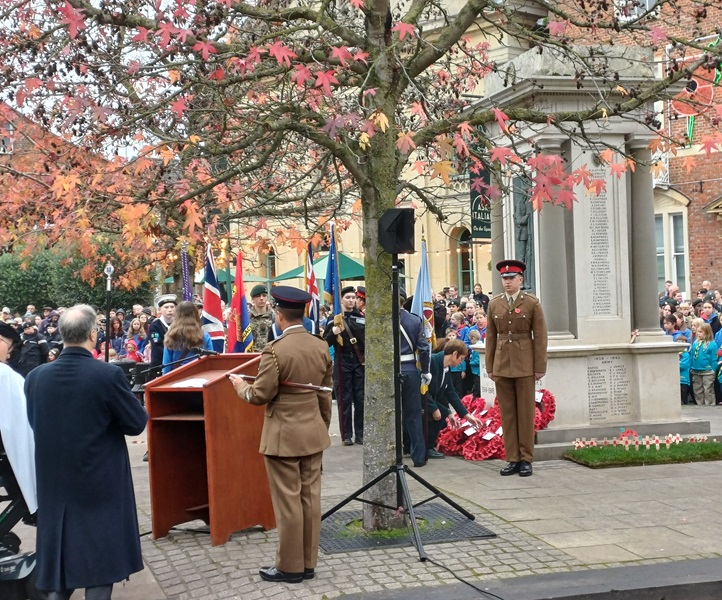
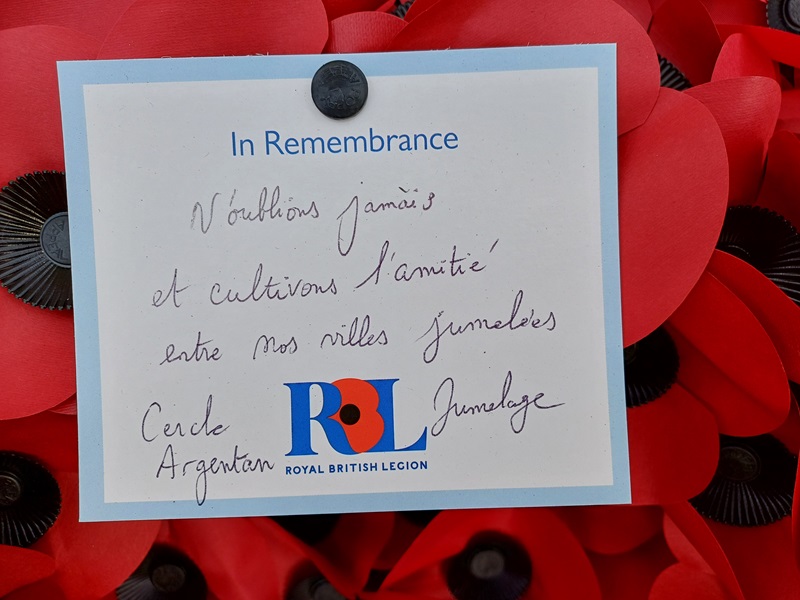
Each year, the Society invites, from each of our twin towns in turn, a representative to come for the Remembrance weekend and to lay a wreath alongside one from ADTTS at the war memorial in Abingdon. In this year of the eightieth anniversary of the Normandy landing, we decided to welcome friends from Argentan twinning. They were Pierette Diard, Marie-Lise Marie and her husband Laurent. Remembrance Sunday began with the civic service in St Helen's Church. From the church, everyone processed up West St Helen Street to reach the war memorial for the traditional short service of remembrance. Marie-Lise laid the French wreath together with our chairman Stella Carter laying the one from ADTTS. After the ceremony, guests moved on to the Roysse Room for the mayor’s reception. Over a glass of wine, there were speeches on behalf of the British Legion and from Councillor Gaby Barody, the Mayor of Abingdon-on-Thames. This was also an opportunity for Marie-Lise to discuss twinning with the mayor and to meet some members of the Town Council. After a break for coffee, Nikki Henton had arranged a traditional Sunday lunch at the Crown & Thistle for our visitors and their hosts.
Evening Meeting – this and thatThursday 17 October 2024 - 7.30 for 8 pm at Preston Road Community Centre Stella opened the meeting with an appeal for ‘our loose change’, so that we could raise £60 to twin our toilet with that in a poorer country without good and universal sanitation. This scheme is called ‘Toilet Twinning’ and in return for your contribution you get a framed certificate with a picture of your nominated ‘loo.’
Stella talked about a more serious trip she and Councillor Lorraine Oates (representing the Mayor) recently made to the 80th anniversary celebrations of the liberation of Argentan, by the Americans in WW2. They attended a parade, concert and reception. One American representative was the grandson of a WW2 veteran, and 30 American army vehicles had been assembled for the event. After the various celebrations, Lorraine and Stella were driven around Argentan in a Willys jeep. This was clearly a moving and solemn occasion. Today I don’t think we can imagine the horrors of the occupation or of the battles to achieve liberation.
When he arrived, he was used to toilet paper, only to be told to use water and your left hand. He procured some newspaper, but was mortified to find in a day or so that the used paper was caught by the desert wind in the morning and distributed for all to see. After that he complied with local custom and ate his communal breakfast using his right hand. The second event was not even funny. The toilet buckets were emptied once a week and woe betide anyone using the toilet at the time. If the emptying crew were splashed, they pursued you and emptied the contents of the bucket all over the unfortunate … The third story was disgusting and horrible. A teacher friend, Steve, had a house on an island in the river Nile. There was no running water (discounting the Nile, which might have been polluted) and so for the disposal of sewage and wastewater from washing, a deep pit had been dug at the end of the garden, screened off by a high wall. (Presumably the flooding river emptied this once a year – we did not hear this detail.) One day Steve returned home and disturbed a burglar, who fled down the garden, jumped over the wall and drowned in the sewage filled pit. After all that we needed a drink of wine, apple juice, cider or calvados, all accompanied by French bread with pâté or a really ripe camembert – delicious, followed by small, open, apple tarts, with or without almonds. I must confess I sampled both. Our thanks to the Abingdon teenagers for sharing their experiences of a trip to Normandy with us, to Harry for telling us about games in Sint-Niklaas, Stella for recalling the 80th anniversary of the liberation of Argentan and Richard for bringing us back down to basics. And special thanks to Nikki and Susan for the delicious refreshments, which rounded off the evening beautifully. One final point, well two: we raised £30 towards the twinned toilet and ADTTS could well stand for Abingdon and District Toilet Twinning Society! Neil Hancox, 18th October 2024 Colmar Twinning WeekendThursday 3 October to Monday 7 October 2024 Connie and Phil Addison and Richard Smart accepted Colmar's invitation to Abingdon Twinning Society for four delegates to attend the Amis du Jumelage de Colmar's Twinning Weekend. Similar invitations had been sent out to the other three of their twin towns with which Abingdon also shares a twinning relationship. There were three participants from Sint-Niklaas, three from Schongau and four from Lucca.
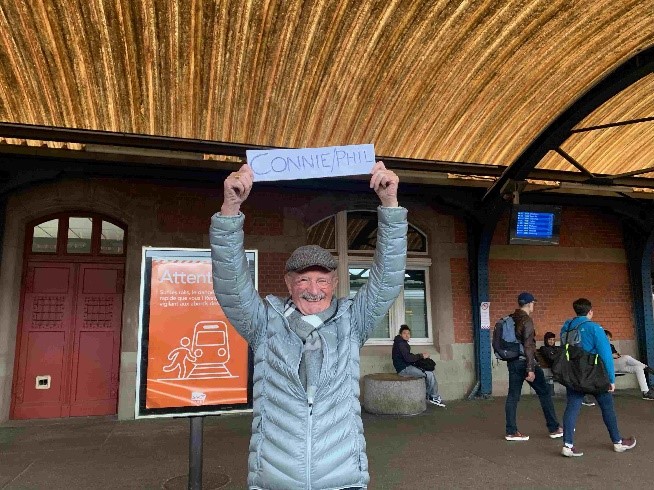
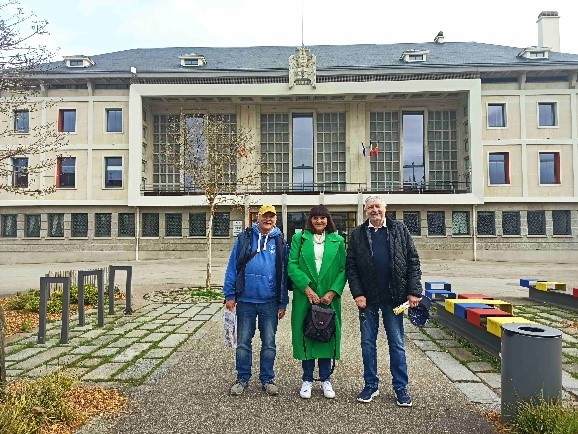
Roland Goetz waiting for Connie and Phil We arrived on the Thursday afternoon, Connie and I were given a lovely late lunch and then our hosts Michelle and Roland whisked us out into the surrounding hills and up the wine route to two of the very characteristic Alsatian wine villages. How many shops selling bottles of Alsatian wine (only), cheese, and Kugelhopfs, and (unaccountably)..... gingerbread men can survive in a small village? To Connie's and my amazement we soon spotted massive nests atop the taller chimneys, and were told they are storks' (!!) nests. The main programme started on Friday morning with a ride on the town's road train through the mazy streets full of typical half-timbered buildings and over the canal bridges. I think it is aimed at town orientation and though we learned much about Colmar, the criss-cross route left us …... disoriented. Fortunately all the Colmar hosts were on hand to guide everybody to the City Hall at 11am for a civic welcome from the Mayor, Mr Eric Staumann.
The Mayor of Colmar and Michele Sengelen-Chiodetti Following this we all met up at the Schongauer Restaurant attached to the Unterlinden Museum (Schongauer the Colmar-born 15th century artist, not the twin town--what a coincidence). I'm just starting the choucroute when a lady tapped me on the back—it was Ingeborg from Sint-Niklaas (who I hadn't yet seen)---with greetings from Siegfried—next thing I know she shows me her phone with Siegfried waving to me. In the afternoon we were taken in hosts' cars to Kaysersberg, probably the most scenic of the wine route villages, (even more gingerbread men but no-one can explain this), and a visit to the Albert Schweitzer museum in the village. In the evening our very kind and generous hosts Michele and Roland had invited Richard and his host Georges for dinner. I think Georges and Richard knew each other before this visit, though perhaps in Strasbourg rather than Colmar. They are a well-matched pair. “Match” is the operative word, it was the European Joke Contest between these two. So Connie and I enjoyed a fairly quiet evening, apart from my attempt to get all six singing Aux Champs Elysees, not a great success, so Tous les Garcons et les Filles did not see the light of evening. Saturday morning saw us at the event in the market-place which was the reason why this particular weekend was chosen by Colmar. The plan was that our hosts guided us through the Fascht. It’s a day-long event in the town centre with food stalls and entertainment (mainly musical). And a hefty discount in the more quality shops to attract German trippers. We found the town is packed packed packed with visitors and large groups not only from Germany but from all over the world. Now that I know something about the separate Alsatian language and culture (thanks to Siegfried's email before we travelled) I guess Fascht is simply the Alsatian word for the German word Fest, a festival or celebration. As in our local “Bunkfest”, etc. Our meeting-up time of 10am seemed to be too early for the musical entertainment, but we were thrilled to see a medieval pageant band from Lucca entering the square playing their instruments and that fantastic throwing up and catching medieval style twirling flags as they walk.
The afternoon was free so Connie and I grabbed the opportunity to visit the Unterlinden Museum. Our first call was of course the Issenheim Altarpiece. Despite this particular gallery being well-populated, the impact of these screens was stunning. The latest renovation was completed in 2022: the colours shine out like they must have done in the early 1500s. It moves you like no other paintings I've seen. What an experience, it’s difficult to walk out of the room and leave it. In the evening we had the celebration dinner with hosts, their families and twin towns' participants--- this was at Le Bistrot des Copains in Cathedral Square, and featured some Alsatian specialities. It was attended by the Mayor and “our” Councillor Michele, and David Mallen and Marc Lischer. During the meal the Schongau ladies Karin Toth and Heike Schuler, in Bavarian folk costume, gave every participant a choice from a huge box of ladies' scarves of various textiles. The final day it was early at the train station for a day trip to Strasbourg, accompanied by a group of the hosts, including David Mallen. The Cathedral's striking size, and the shape of spire make it most memorable. We caught an amazing temporary exhibition of drawing plans for the cathedral's building and subsequent additions and alterations in the Cathedral Museum. This definitely caught Connie's interest as she had been struggling for a few days before we left with the proportions of the Abingdon Museum in a painting she presented to Michelle. Due to a fire brigade call-out in a neighbouring street blocking the traffic the road train had to cease operations, but we thoroughly enjoyed the bateau-mouche trip whose onboard audio guide was brilliantly interesting and informative. Following a nice speech of au revoir from David on arrival back at Colmar station, we sadly had to part and we all said our personal au revoirs to our new friends. In the evening our most hospitable and generous hosts Michelle and Roland took Connie and me to a traditional Winstub (a Weinstube) in one of the Wine Route villages. Another big moment was to come, our lovely meal was accompanied by glasses of Gewurztraminer, coincidentally one of Connie and my favourite white wines for a special occasion. But, unlike any we've drunk before, this was straight from the vineyards who produced it, the aroma and taste were just so intense. Aldi or Lidl offerings will never be the same again. A lovely end to the fantastic hospitality and generosity we were privileged to enjoy with Michele and Roland and the Colmar twinners. Many grateful thanks to all involved. Philip Addison Evening Meeting - AGMThursday 19 September 2024 - at Preston Road Community Centre
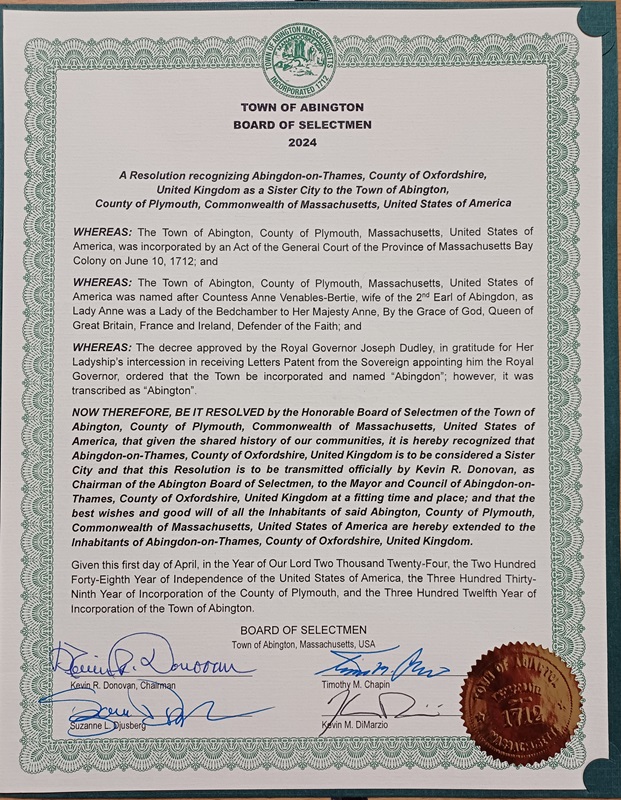
The Society's Chairman, Stella Carter, welcomed to the meeting Councillor Gabby Barody, who is the current Mayor of Abingdon. Nick Marsh agreed to take the minutes. The business followed the usual format and was despatched thoroughly, but efficiently. The papers for the meeting had been available on the Society’s website for members to see in advance. The accounts were presented by Ian Jardine and approved. Bruce Hunt had been most helpful as official examiner. Stella Carter, in her Chairman's report, described many personal rewards from twinning during the year. Moving on to the future, Stella outlined the draft programme for the coming year. An interesting series of monthly meetings is planned, as well as the customary Christmas Lunch, Europe Day Meal and summer Garden Party. On Remembrance Sunday, a twinning wreath would be laid this year by a representative from Argentan. Following the success of the recent treasure hunt, there would be another one next July. The Mayor took the chair for the elections. The meeting was happy to re-elect the present officers and committee. (See the website for details.) Concerning was the continuing lack of a Secretary to coordinate the delegated responsibilities. Rosemary and Ian Jardine, who have acted as treasurers for so many years, announced that this would be their final year in the post. New Sister City While a formal town twinning treaty is not envisaged, the Mayor on behalf of the Council welcomed this invitation to a new friendship link. It adds to the established friendship link with the town of Abingdon in Virginia. Councillor Barody said they would invite representatives to the Mayors’ conference. Church Twinning In November2023 a Barn Dance was held with the bourrée band from Argentan, which was a popular and well-attended event. In April 2024 a group from Schongau visited Abingdon. At All Saints they heard of Methodist history. The group also visited Oxford and took part in a service and meal at St Michael's church. In June 2024 a group from Sint-Niklaas visited the Abingdon Passion Play. The group also went to Oxford, made a walking tour of Abingdon and made visits to Christ Church Abingdon and Peachcroft Christian Centre. Future events: In November there will be a fund raising quiz for the Group and a charity. In 2025 they anticipate an invitation from Argentan or Sint-Niklaas. They hope to invite the bourrée band again. Conclusion The evening concluded with members informally socialising over wine together with cheeses, etc., prepared by Nikki Henton. Sint-Niklaas Twinning WeekendThursday 5 September to Monday 9 September 2024 Sint-Niklaas Twinning (VZW DE VERZUSTERING) invited four people from each of their twin towns to participate in a twinning weekend. This took place from Thursday September 5 (arrival) to Monday September 9 (departure). As always, the program was somewhat linked to the Peace Festival (balloon festival) that takes place at the same time. This year the theme was ART AND PARKS. The guests who went from Abingdon were Penny Clover, Harry Stoopman, Susan and Brian Read. Others came from the twin towns of Colmar, Lucca and Schongau. The programme over the three days was excellent and we thank the twinning team in Sint-Niklaas for their great hospitality. Below are Penny's impressions of the weekend.
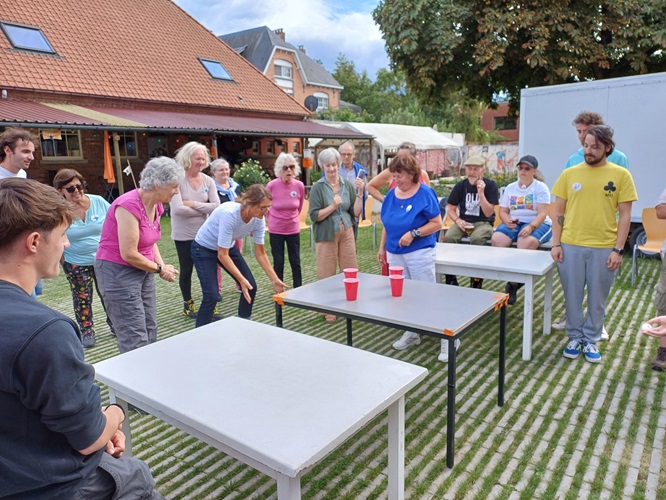
A 3-hour delay for Harry & me on our coach from London to Brussels because of problems with Le Shuttle meant that we missed the introductory evening. Our host, Joris, was confused about the exit from the station we described until he realised the problem. We were, by that time, so keen to get there that we’d left the train one stop too early! But he and Nele gave us a warm welcome. The first day was a trip to see sculpture and arts and meeting all the other “twin reps” with lunch on the dunes. The visit to Ostend included the famous artist James Ensor with varied styles and skills with music composition, and his house were all interesting. We’d discussed our bikes at home and so with our hosts and borrowed bicycles we explored areas around. Joris had worked prior to retirement on developments around new buildings, and he showed us the now mature green spaces and varied ecosystems. The trip ended with a beer in the sunshine. The Balloon Festival was a little disappointing as the weather was not suitable for launching. We saw one or two inflated in the Market Place, but the rest of the town had street food and several music stages, where we saw incredible lights and bands. Gradually we got wetter through the evening but it was warm and no-one minded followed by spectacular fireworks in the market place. For me a real highlight was our supper at Joris and Nele’s home with 10 of us, hosts and “twins” as guests enjoying wine, cheese, breads and good mix of conversation in so many languages. We particularly noticed the 4 young men from Lucca (most of us much older) but hope they found we were good fun too! On Sunday we visited the older parts of Sint-Niklaas with much Art Deco architecture to investigate including the school / church buildings with amazing tiles and stained glass. The finale was a series of games as “Jeux Sans Frontières” with mixed teams and silly contests that everyone enjoyed before what was described as a BBQ but in fact was a star-quality catered meal from a van in the car park. This was our first trip to a twin town, and we understand what it means and how it all works, a great group of people sharing their town and real quality friendly and interesting time together. Penny Clover
Blue Plaques Treasure HuntThursday 18 July 2024
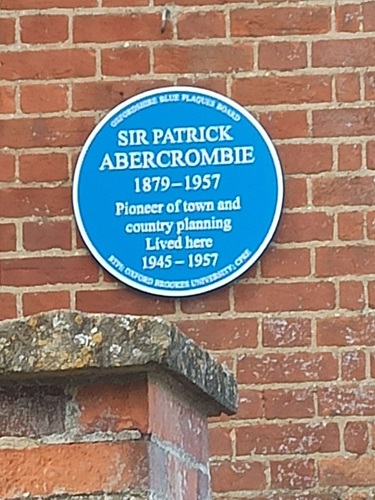
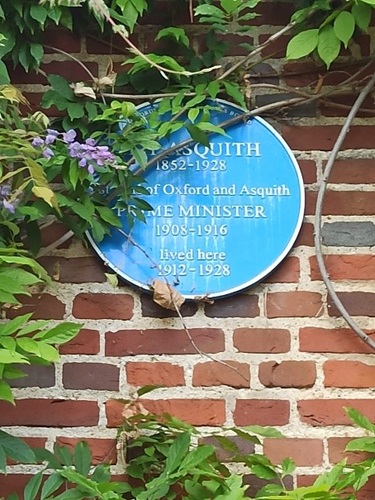
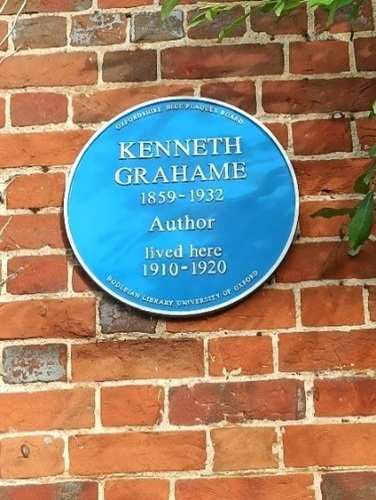
The different routes took the teams through some beautiful local villages, and on locating the plaque they had to answer questions based on the information on the plaque. The search was great fun, and occasionally teams would arrive simultaneously at a plaque, where they shared information in a truly sporting fashion – although some of the more competitive teams were reported to have resorted to the dastardly sharing of bogus facts!
The winners, as well as the runners up, were awarded some excellent prizes in the form of boxes of chocolates which we enjoyed in the pub. It was a really splendid evening, and we all look forward to the next Treasure Hunt. Huge thanks to all the organisers, Stella and Howard Carter, Nikki Henton and Peter Dodd for putting this event together. Nick Marsh Annual Garden PartyFriday 12 July 2024 - at St Ethelwold's House, 30 East St Helen Street, Abingdon OX14 5EB
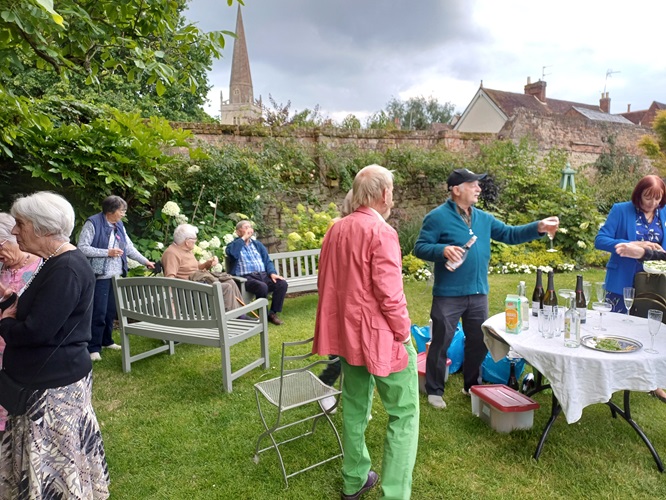
What better way to spend a day than sitting in the sun, sipping Prosecco, chatting to friends, new and old, and nibbling delicious savouries. That was the ADTTS garden party held on Friday 12th July at St Ethelwolds. Those of you of a pedantic nature will point out that it was in the evening and the sun was perhaps a little bashful. Nevertheless, it was still a delightful time. I have it on good authority (i.e. I overheard it) that 14 bottles of fizz were consumed by 29 guests. Our taste buds were more than satisfied by prawn vol au vents, a particularly tasty quiche with an onion marmalade base, and many more treats, prepared I understand by Susan and Nikki. Our thirst was quenched by Howard manning the 'bar' on the lawn. Apart from catching up with the news and talking, you could wander round the beautiful garden at St Ethelwolds, where weeds appear to be banished (unlike my patch) and flowers bloom. Even vegetables make an appearance in one corner. After an hour or so a dark cloud emptied a little rain onto the gathering, to remind us possibly who really is the boss. Unlike some of the hardier guests I have to admit that I disappeared into the garden room (by which time the shower had passed) It was a most enjoyable occasion, and our thanks are due to Stella for organising things, Howard for his work behind the bar, Lorraine, Nikki, Rosemary and Susan for their culinary output and all of you for coming. Neil Hancox, 13th July 2024 Church Twinning with Visitors from Sint-Niklaas for the Abingdon Passion Play20 - 24 June 2024 Nine visitors from Sint-Niklaas, representing diverse ages, faiths (Protestant and Catholic), and genders, arrived in Abingdon on Thursday afternoon. After a warm welcome and refreshments at 35 Ock Street, they received a tour of Abingdon Baptist Church, including a discussion on baptism. In the evening, visitors could socialise at "The Loose Cannon" brewery or with their hosts. Friday included a guided Oxford tour led by Peter Dodd. The evening saw a lively night of music at "The Loose Cannon" brewery (1).
Saturday featured a tour of Abingdon's sights led by Anne Dodd. The town crier led some visitors to the Abbey Gardens, while others explored St. Nicolas Church with its stained-glass window dedicated to St. Nicolas / Sint-Niklaas (2).
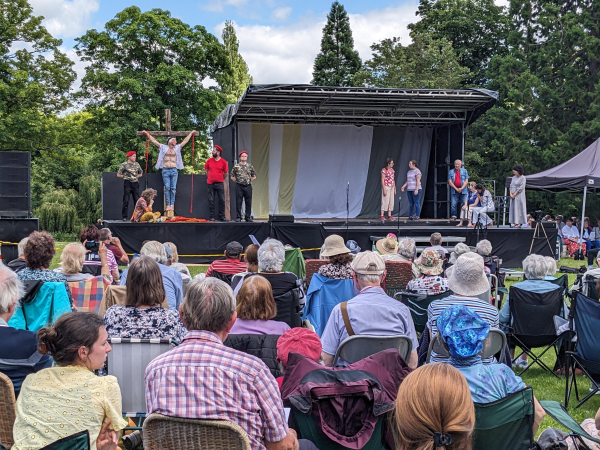
The highlight of the visit was the moving 20-scene Abingdon Passion Play held outdoors in the Abbey Gardens (3). The performances captivated the Sint-Niklaas visitors and they knew Sally Mears and Hazel Glennie through the church twinning. Sally was responsible for arranging and conducting the music, while Hazel took on various roles in the performance, including the character of Mary. After lunch, the visitors enjoyed seeing the election of the "Mock Mayor of Ock Street." This event featured Morris dancing and music. The visitors met the candidates for the Mayor of Ock Street (4) and were glad to see the inclusion of a female dance group. The evening concluded with a meal at The Broad Face, featuring traditional English fare and lively multilingual conversation (5).
On Sunday, visitors accompanied their hosts to different churches in Abingdon, experiencing the variety of worship available within the town. Chris De Beer, the Sint-Niklaas group leader, spoke of the importance of fellowship across denominations. In the afternoon visitors could relax or explore Abingdon with their hosts. In the evening visitors and hosts met for the closing service at Our Lady and St. Edmund Church (6). The service included a lovely hymn sung by Jacob Burm in Flemish (7) and everybody lit a candle.
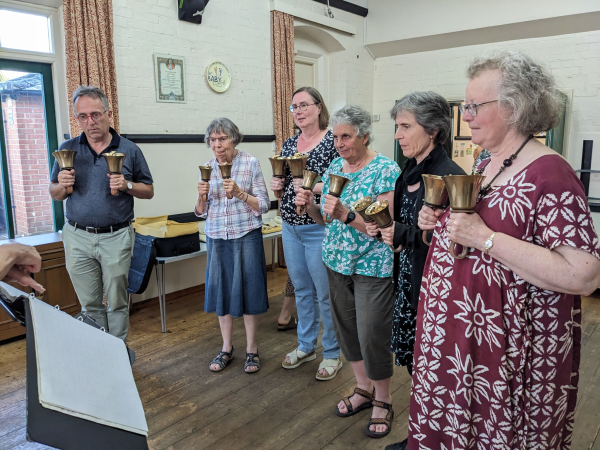
Afterwards, in the church centre, gifts were exchanged (8) and people were taught to play handbells by Susan Read (9). There were also drinks, savouries, and a few cakes.
Monday saw a discussion about the Abingdon Passion Play, contrasting it with Sint-Niklaas' production. Eileen Bontempelli guided visitors through the Christchurch sanctuary, sharing its history and the lively nature of Christchurch worship. The visitors then visited the Peachcroft Christian Centre, a Protestant multi-denominational centre, before enjoying a final lunch. The weekend was a powerful example of church twinning and the ecumenical spirit. Thank you to the visitors from Sint-Niklaas for being such good company, to everybody who worked so hard on the Passion Play, and everybody on the church twinning committee for their planning and support. A special thanks to the hosts who welcomed visitors and made their stay enjoyable. Alastair Fear Group Visit to the BMW MINI Plant in OxfordTuesday 21 May 2024 - at the MINI Plant Oxford, Cowley, Oxford OX4
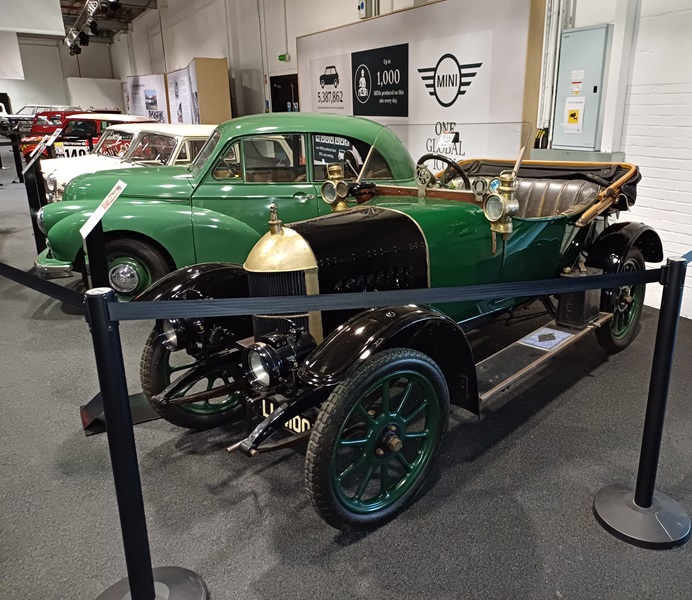
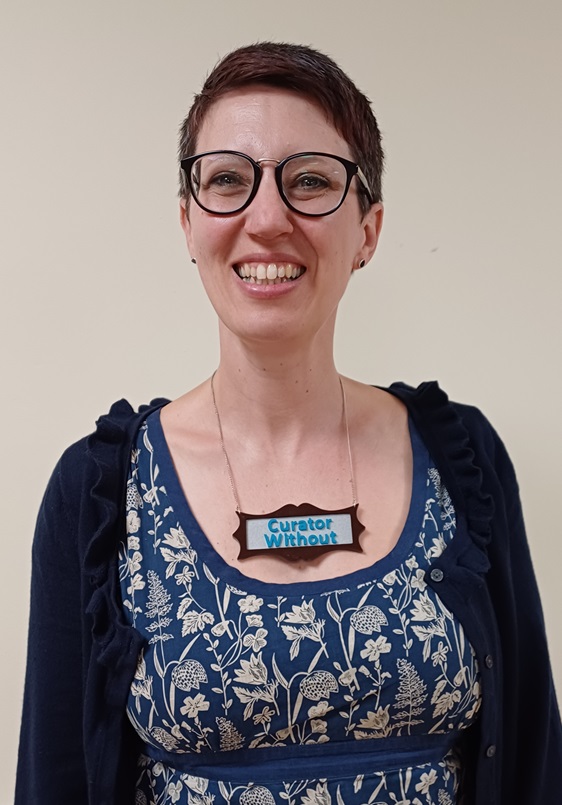
When we were all assembled the preliminaries commenced, the all-important safety briefing – where to walk, where not to walk, keep together, what audio signals to listen for etc., as the vast factory had roadways inside, which were used by vehicles taking the necessary parts to the different machining cells. We were also given hi-vis vests to wear, as well as safety goggles to prevent glare from welding robots. It’s a good job there weren’t any teenagers amongst us as we were all told to surrender our phones for the duration of the tour – no clandestine photos of secret processes or new, as yet unreleased models, were to be taken. The tour itself, around 90 minutes long, was absolutely riveting, our guide was knowledgeable and entertaining. The so-called Body in White facility was massive, covering an area equivalent to around 45 football pitches, and encompassing dozens of fully-automated machining cells each putting together a certain section or complex part, and these parts eventually come together on the production lines where the shells move along, gradually acquiring more and more parts until the finished object is eventually driven off the end of the production line. The process takes around 4.5 hours. It was fascinating to watch the robots in action handling the parts and performing their tasks such as joining, riveting, welding, drilling etc. with absolute accuracy. In one part of the process the shell goes to the paint shop – each car is painted to order. One strange aspect of the paint process was that the final polish is done using ostrich feathers – synthetic materials are not suitable due to the static electricity they generate! A fascinating experience, and one I would highly recommend! Nick Marsh Evening Meeting - Blue Plaques of South OxfordshireThursday 16 May 2024 - at Preston Road Community Centre Marie-Louise Kerr, local historian and "Curator Without Museum", told us about famous local people and the stories behind those blue plaques.
Our guest speaker at May’s Thursday evening meeting, Marie-Louise Kerr entertained us with stories of people behind other blue plaques in south Oxfordshire. Who knew for example that Wallingford, a small Thames side town of only about 12,000 people could produce not one but two of our greatest authors. Dame Agatha Christie lived at Winterbrook and is buried in Cholsey churchyard and comes in third in the bestsellers list, behind the Bible and Shakespeare. The second author, also hugely influential, was William Blackstone, 1723 - 1780. Never heard of him? William Blackstone wrote Commentaries of the Laws of England between 1765 and 69. Continuously updated Blackstone’s is the bible of the English law courts today. Each court will have a copy and it is quoted from all the time. What I didn’t know however until Marie-Louise’s talk is that it was used as the basis for the American Constitution as well as many others around the world. Another author, Kenneth Grahame of Wind in the Willows fame lived not far away, in Blewbury. Many people may know that, but we also learned that Grahame was also Secretary of the Bank of England, one of the three highest offices in the bank. Yet another author, Poet Laureate, John Betjeman was also highlighted. He lived in Uffington. He was also a Secretary, of the Oxford Preservation Trust. Marie-Louise didn’t just focus on authors. She took us on a tour of the countryside from Jethro Tull in Crowmarsh Gifford and the agricultural revolution with the invention of his seed drill to Cecil Kimber in Northcourt, Abingdon, the designer of the MG. Then we learned about Asquith, Prime Minister in 1908, from Sutton Courtenay and Roy Jenkins, Chancellor and also first President of the European Union. Perhaps less well known is Dame Jennifer Jenkins, Roy Jenkins’ wife. They lived in East Hendred where there is a double plaque for them. Jennifer Jenkins became Chair of the National Trust and the Heritage Lottery Fund. Marie-Louise’s last question to us was to think of our favourite blue plaque. I have thought about this and I know mine, but it is not local. It also made me think that if say eight or ten members could come up with their favourite blue plaque one of our winter meetings could be dedicated to telling the stories behind them. No more than five minutes each. What do you think? We also hope to put together a blue plaque treasure hunt in July. Look out for further details. Stella Carter Europe Day MealThursday 9 May 2024 - at The Cosener's House, 15 - 16 Abbey Close, Abingdon, OX14 3JD
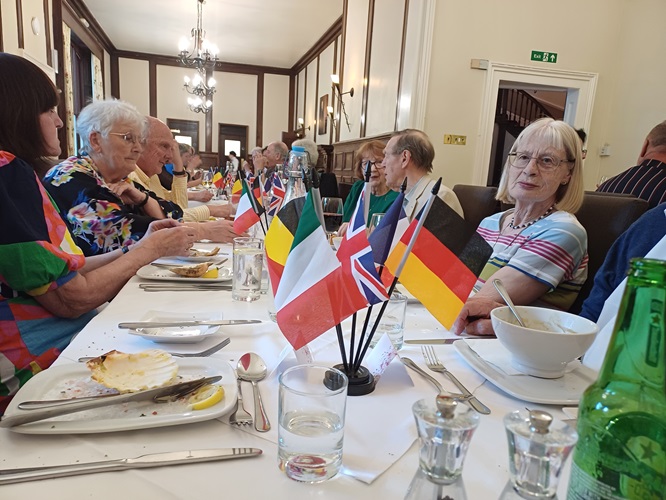
The date of 9th May each year is Europe Day, whose origin stems from when the second world war officially ended. It is an annual custom in ADTTS that we take the opportunity to assert our European outlook and celebrate Abingdon’s twinning links by meeting together for a meal. This year the dinner was in the delightful setting of The Cosener’s House, with an imaginative menu featuring dishes that reflected the cuisine of each of our twin towns.
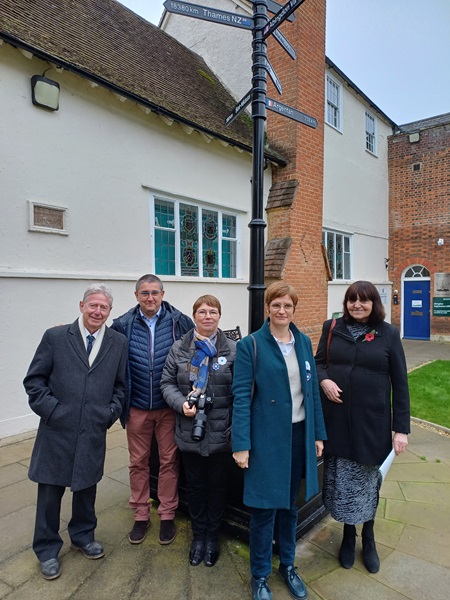
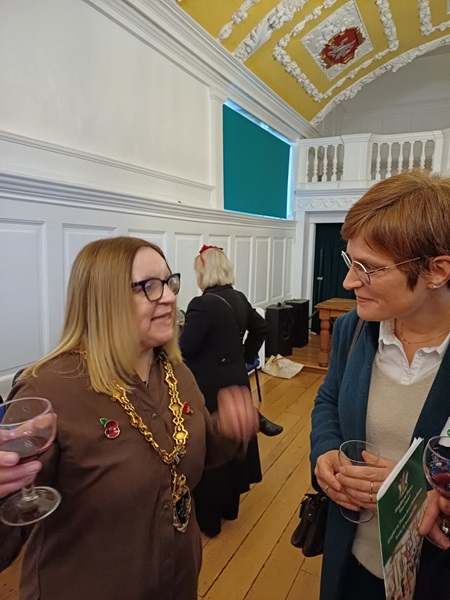
Unveiling of the Twinning SignpostThursday 9 May 2024 - 6.00 pm outside the Roysse Room in Bridge Street It has been a long time in gestation, but, thanks to the Town Council, Abingdon has at last its own Twinning Signpost! It has been erected at the Guildhall, just outside the Roysse Room and town council offices. The signpost indicates the distances and directions of our five twin towns (Argentan, Colmar, Lucca, Schongau and Sint-Niklaas) and to two distant towns with whom we have friendship links (Abingdon in Virginia and Thames in New Zealand). The success of this project reflects the persistence in particular of Councillor Lorraine Oates in pursuing the idea, along with support from ADTTS. The signpost, a traditional fingerpost, was manufactured in Buxton by Leander Architectural and completed in position by adding the directional arms or fingers just in time for its presentation on Europe Day (9th May). The signpost was officially inaugurated by the Mayor of Abingdon, Councillor Gwyneth Lewis, in a public ceremony with many members present in glorious evening sunshine. The value and importance of twinning links were emphasised in three short speeches by the mayor, Stella Carter for ADTTS, and Lorraine Oates for the town council. The proceedings concluded with an invitation to drinks in the Mayor’s Parlour. Planned now is an information board to accompany the signpost that will, for the benefit of visitors and curious passers-by, describe the main characteristics of each of the twin towns. Overall, this venture should raise the profile of twinning in Abingdon and the value of strong international links.
Evening Meeting - About Our Twin TownsThursday 18 April 2024 - at Preston Road Community Centre This meeting was originally planned to have speakers from the different Oxford City twin towns associations to come and tell us about how twinning operates in Oxford. Unfortunately, we had very little response from the organisations apart from Leiden. Instead, the meeting was held to invite our members to give us their ideas on what should be put on the planned new notice board which will be erected near the new Twin Towns Signpost. This signpost will be unveiled by the Mayor of Abingdon on Thursday May 9th Europe Day.
Oxford has a very good notice board about their twin towns at Carfax. We have photographs of this and ours will be like it only smaller. Malcolm from the Oxford Leiden link was able to tell us more about it. Nick then showed us a PowerPoint presentation about our twin towns and sister cities which contained the most important information about them. We then went through the twin towns one by one and people were free to say what they would like to go on the notice board. People have different favourite memories of the twin towns such as the storks in Colmar, the walls of Lucca and the wartime memorials of Argentan. These comments were all recorded and will be used to design the notice board. We finished with refreshments on a twin towns theme – Camembert cheese, German sausage and Belgian beer and chocolates. Peter Dodd Twinning Trip to LuccaThursday 11 - Monday 15 April 2024
After this superb tour we enjoyed some refreshments at a café near the cathedral, and were very pleasantly surprised when Herman and Mia from Sint-Niklaas joined us. While there, most of us purchased tickets for a concert to be held the next day in the Church of San Giovanni on the same square. The afternoon was free, so most of us wandered around Lucca in small groups, having super gelato at a café recommended by Maria, drinking coffee and revisited some of the sights we had seen in the morning.
On arrival back at Lucca, we went to a “Twinning Day” event, where the President of Twinning Lucca, Duccio Lorusso, hosted a meeting primarily aimed at getting younger people into twinning. Maria also spoke and ably translated the speeches, including that of our own Ian Jardine! After this some of us headed for dinner in a restaurant followed by the concert at 7 pm. The meal was excellent as was the concert! At the concert tenor Joseph Spratt and soprano Carmela Maffongelli performed a number of pieces including works by Wagner, Puccini, Rossini and Verdi, accompanied by Diego Fiorini on piano. A delightful concert in a beautiful setting. On Sunday morning some of us attended Mass in the stunning cathedral, with the rest of the day free to explore Lucca. The final event of the weekend was a trip to two noteworthy Lucca bridges, which was enjoyed by all participants. A fine weekend indeed with many highlights both culinary and in terms of sightseeing, made all the more enjoyable by Maria’s excellent guiding! Nick and Jacqui Marsh Visit to Argentan for La Fête de la NormandieSaturday 16 - Sunday 17 March 2024 - Argentan
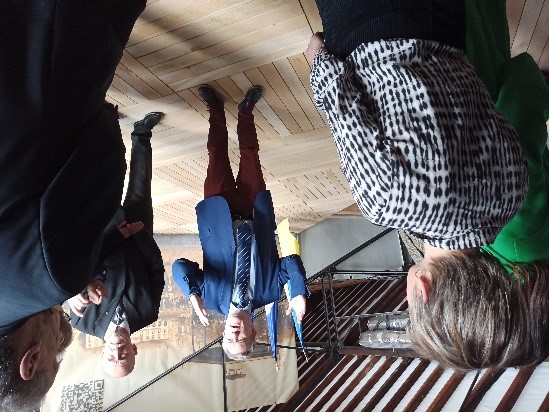
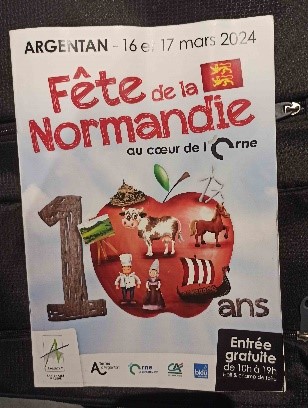
On the early evening of Friday 15th March Stella, Howard and I left Abingdon by car en route for Portsmouth and the overnight ferry for Caen, from where we were to drive the short distance to Argentan to attend a twinning weekend for La fête de la Normandie. After a coffee stop in Falaise on the way we arrived in Argentan around 9 am and drove to Eric and Odile Lecrosnier’s house where Stella and Howard were staying, a quick breakfast and then off to the first event of the twinning weekend – a reception in the town hall hosted by the Mayor of Argentan, together with the delegation from the Argentan Twinning Society, and guests from other twin towns Miki Hadju and his wife from Baja in Hungary, and Karin, a teacher from their twin town of Rothenburg, Germany, who was leading a party of school children on a cultural visit to Argentan. Following the reception there was the official opening of the Baja Room, with the cutting of a ceremonial ribbon by the local dignitaries and Miki Hadju the Vice Mayor of the city of Baja, as well as Stella, representing Abingdon. Following this we were led upstairs to the top floor of the City Hall which was being renovated, and where one of the rooms was to be named “The Abingdon Room”. Out came the scissors and ceremonial ribbons once more and our Chairman, Stella, did the honours!
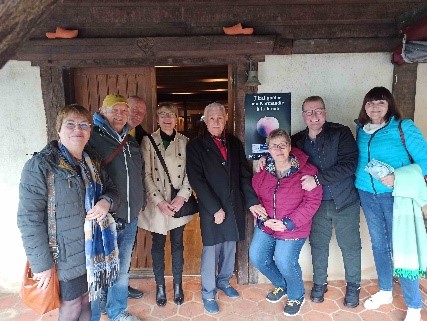
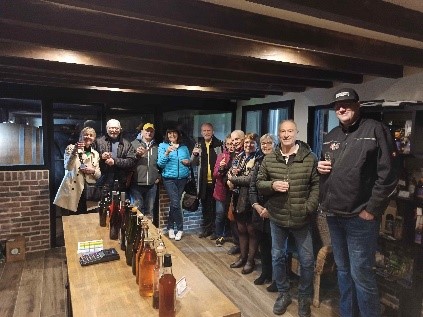
Then on to the Festival we processed, and into a massive, long marquee containing at least a hundred Normandy cows, including Oreillette, a bovine superstar who was the most famous and most photographed cow in France, having featured in many advertising shoots! Suitably impressed, we left the marquee and entered the exhibition hall where there were dozens of stalls featuring local produce such as cheeses, wines, spirits, beers, snails, which we were keen to sample (and yes, the snails were delicious) as well as handicrafts from Normandy. Lunchtime approached and we were treated to a sumptuous 4-course lunch - those Normans certainly know a thing or two about food and drink! After lunch we visited the Fernand Léger – André Mare museum, which was excellent, following that a couple of free hours where some of us rested and tried to sleep off the lunch. In the early evening Mark and Sandi Lane had invited us to join them in their historic and stylish home for canapés and drinks. You may remember Mark gave a very interesting talk about D-Day last month. It was then just a short walk to the Le Bistrot de l’Abbaye restaurant for a truly splendid 4-course meal, with a couple of amuse-geules*. The choice of starters included snails, fish, soup, the main course was a choice between cod, beef or pork, all beautifully and freshly cooked (no “out of the freezer and into the microwave” here). Delicious desserts followed and coffee. We staggered out, bloated and merry, luckily my own accommodation was right next door! The next morning saw us being driven a short distance to the Maison Perigault cider and Calvados production farm, where we were given a guided tour of the cider cellar and distillery by the owner, who also explained the workings of a typical Pays d’Auge pot still to our group. This was followed by a tasting session of almost their entire production, apple juice, various ciders, perry, Pommeau, Aperi’go (an aperitif), and a whole host of Pays d’Auge AOC Calvados aged from 12 to 40 years. Unsurprisingly, many of us bought bottles to take home.
Lunch was in a former village school – but this was no school dinner – rather yet another gastronomic repast with superb wines and ales. The afternoon was spent at the Memorial of Montormel. In August 1944 the last major conflict of the Normandy campaign took place in the so-called Falaise-Argentan pocket, where the Allied forces encircled and destroyed a major part of the German forces. Although tens of thousands German soldiers managed to escape, there were heavy losses on both sides. The German losses were huge, with about 10,000 men killed and 40,000 to 50,000 were captured. This Memorial on top of Mont-Ormel gives a panoramic view of the valley of the River Dives, including the so-called “corridor of death”.
This was a profoundly moving experience to think of the waste of so many young lives, and even more intensified by the thought of the same carnage now happening in Ukraine. The museum housed many artefacts from this time, some of which, including knives or other equipment from the war, had been donated by grandfathers, uncles and other family members of our hosts.
The evening saw us saying our farewells after a meal in a Chinese buffet restaurant. This was an incredibly well-organised weekend, with an astonishingly interesting and varied programme - the hospitality of the Argentan Twinning Society was legendary, our enormous thanks are due to the town of Argentan and the members of the Argentan Cercle de Jumelage, who all made sure we had such a great time! Nick Marsh Photos: Nick Marsh, Howard and Stella Carter *Pedants’ corner: an amuse-bouche or its more informal twin amuse-geule, is literally a “mouth amuser”, a small, generally complimentary titbit served as an extra while you are waiting for your first course. Bouche means human mouth, while geule is more generally the mouth of an animal and is also used in slang expressions e.g., …ta geule! The plural versions, amuses-geules or amuse-geules, are both acceptable (according to several reference works). Evening Meeting - "Morris Minors in the Media"Thursday 21 March 2024 - at Preston Road Community Centre
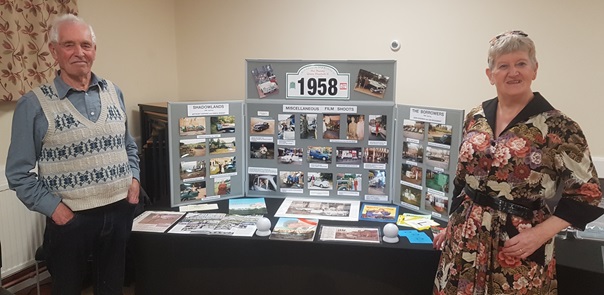
The Morris Minor and a Car Hire Company with a Difference The Morris Minor, that small car produced post war by Lord Nuffield’s Morris Motors, brings back memories for me. A holiday trip with my cousin Michael through Northern Europe and well into Norway, in the early 1960s in his tourer version, and my father’s final car, the saloon model, which lasted him through a long retirement and took us all over the UK. Bless you XWP 11. To celebrate the production of the millionth Minor, a special limited edition of the car, in pink, was to be produced. Unfortunately, a suitable pink paint could not be formulated so 350 lilac-coloured cars were made. At the March ADTTS meeting Ann and John Ford told us of their long involvement with Morris Minors. ‘It had always been John’s dream of buying one of these lilac cars,’ Ann told us. When he did acquire one the proud owners used to take it fetes and meetings. One day they found a note on the windscreen. It turned out that their car might be of interest to film companies, and so began a 25-year long business, hiring their cars out as props, initially to film production companies. It was both stressful and rewarding. Eventually they had ten or so Minors of their own and could call upon up to another 300 throughout the UK. The first film they and their cars were involved in was Shadowlands, starring Anthony Hopkins and two identical Morris Minors – and Ann stressed, that meant identical, even down to the same number plate. Hopkins became a friend and in some of the driving scenes, John acted as his double. The next film, The Borrowers, was rather more challenging, as 32 Minors were required. However, Ann and John managed to provide these and later went to the premier and the party afterwards and acquired a Borrowers T-shirt, which John proudly showed to us.
As the film work dried up, they turned their hand and their cars to sitcoms. and even the Antiques Roadshow, in which Ann had to drive Fiona Bruce around Oxford on a chilly May morning. Then there were commercials for a famous grocery supermarket and an equally famous breakfast cereal. The former had John, in a blond wig, as the original driver had panicked, driving along Guildford High Street. Unfortunately, the makeup department had forgotten to remove John’s moustache! The latter was scarier – it involved a tiger climbing on to the roof of the car. Afterwards they noticed four dents in the roof panel. Fortunately props departments always make good any damage caused and the car ended up better than ever. And finally, weddings, charity events and ferrying celebrities, including the then Speaker of the House of Commons, Bernard Weatherill, around London. This was a very enjoyable event, and I am sure we were much less demanding than many of the previous ‘customers.’ As always, we finished with refreshments, thanks to Nikki, Norma and Susan, and - this time a picnic with Prosecco, a nod to one of the events Ann and John had been involved in – an advert of a mock picnic on the M25. Neil Hancox, 22 March 2024 Evening Meeting - D-DayThursday 15 February 2024 - at Preston Road Community Centre In preparation for the D-Day commemorations in June for the 80th anniversary of D-Day, Mark Lane came from Argentan to give a talk about the invasion of Normandy by the allies in 1944.
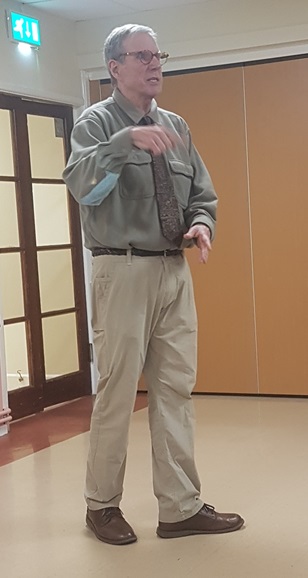
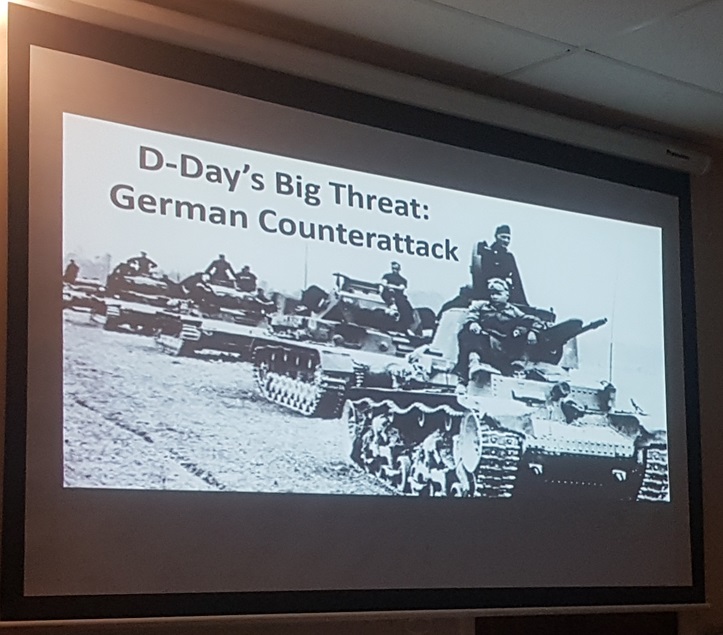
Mark summed up WW2 in six words – American steel, Russian blood and British deception and then went onto give a thumb nail sketch of the origins of the war. He started with ’the long fuse’, the Industrial Revolution of the 18th century. Better machines meant greater food supplies and a bigger population, seeking to expand. In the late 19th century, there was a second industrial revolution, this time particularly in the USA and Germany. Cheaper newsprint meant that poorer people became better educated and informed about the world. Germany wanted an empire to rival that of the UK and France and Mark suggested that this ‘empire envy’ caused WW1. Fast forward to the Treaty of Versailles, where Germany was required to pay massive reparations, especially to France, which had seen so much of its country devastated – also the French wanted to get their own back for the reparations they had been forced to pay Germany after the Franco-Prussian war of 1870. In the interwar years peace movements grew apace in the UK, France, and the USA but in Germany the mood was one of vengeance. Germany felt that it had been stabbed in the back in 1918/9 and the Jewish population became scapegoats for this (yet again). The Great Depression starting in 1929 caused banks supporting Germany to withdraw their support leading to political instability, hyperinflation and ultimately the rise of Hitler. The threat of Russian communism was another factor causing alarm in Germany and elsewhere. In countries other than Czechoslovakia, there was a movement to the right politically – towards fascism. Hitler was much influenced by a book, the Decline of the White Races, written by American, Madison Grant, and published in 1921. Among other points this suggested that the white, Nordic races, came south into Europe from Norway and led to Hitler’s obsession with that country. Another event of great significance in the interwar period was the production of the Enigma coding machine. The Poles acquired some and Marian Rejewski studied their operation. Later in the early 1940s The British, (e.g. Alan Turing, though many more thousands were involved) became heavily involved in code breaking. Incidentally Mark pointed out that people with mathematical and/or linguistic abilities were especially good in this area – that lets me off! The German external intelligence service, the Abwehr, was headed by Admiral Canaris, a man Hitler originally trusted. However, Canaris became disillusioned with Hitler, took part in the July 1944 plot, and paid with his life. It is also believed that Canaris supplied information to General Franco which persuaded the latter not to throw in his lot in with Hitler. Germany was very successful in capturing Allied agents in France and Holland, maybe 100 or more died, but less successful with their own agents they planted in Britain. Most were soon captured and turned into double agents, though it was doubtful how well they could be trusted. A particularly interesting and useful double agent was Juan Pujol, known as Garbo. He was a Spaniard, who after the Spanish Civil war, went to Portugal and tried to enrol as a spy firstly for the British, who were initially not very interested and then for the Germans who were. He then went back to the British and worked for both masters, to great effect for the Allies. Hitler was obsessed with Norway, as has been noted, and eventually stationed 200 -400,000 troops there. Meanwhile he built a defensive wall, or series of linked strong points along the French coast through the low countries and western Denmark and up into Norway. The idea was that any point that was attacked could be quickly reinforced. The British and Allies needed to create uncertainty as to where the landing in Europe would be. They had to deflect attention from Normandy and make Hitler think that the Calais area was very likely – the Germans would have used this for an invasion of the UK - and Norway. It was decided that dumping a body at sea together with incriminating papers (Operation Mincemeat) could not be used again. So apart from false information conveyed by double agents the British built large dummy installations, of tanks and landing craft in the Kent area and in eastern Scotland and arranged for radio traffic to appear to originate from those areas. As an illustration of the care taken dummy tanks were moved overnight and actual tank tracks left as evidence. In Scotland multiple, small, fires were lit at night to indicate the presence of foreign troops. The landings were successful, deception had done its work.
This was fascinating talk, delivered without notes and with some excellent simple slides to back it up. Let me stress three points. This did not in any way glorify or diminish the horrors or the evil of WW1, WW2 or all wars and conflicts. Secondly in a talk of an hour or so it is only possible to give a snapshot of a few areas and individuals. Such a vast subject would need a book, many books, to do it justice, and this has to be appreciated. Finally on a more academic point, I am sure you all, and amateur and professional historians, could argue over some of the themes – e.g. did empire envy cause WW1? – forever. That is a luxury that those of us fortunate to have survived, so far, these terrible events, have. Our thanks to Mark for different take on D-Day and a most interesting and stimulating talk. And, as Napoleon said, an army marches on it stomach, and an ADTTS audience does as well. To aid this Nikki, Connie, Susan, Stella, and Howard, fed us on baguettes, French cheeses, cider and calvados. Neil Hancox 16 February 2024 Evening Meeting - QuizThursday 18 January 2024 - at Preston Road Community Centre
Our genial quiz inquisitors, to borrow a phrase from TV or radio from way back yonder, Peter Dodd and Brian Read, subjected the brains of 20 or so enthusiastic twin towners to several rounds of memory testing questions. For good, measure they also threw in a couple of tasks requiring digital skills / judgement and one needing basic arithmetic. Yes, we all survived, just. The evening opened with a very pleasant announcement, one of our members, Margaret Simpson, had received the MBE in the recent honours list. And then it was eyes down, pens at the ready, did you hear that, adjust hearing aids, and the answer is… To keep us occupied throughout the evening we had to guess the second most populated city in a list of European countries. In one or two cases I didn’t know they had second cities, and there were several more that caught us out. While we argued about this and tried to figure out the distance involved if a journey at 20mph took 10 minutes longer than one at 30mph, we answered questions on Abingdon local history, twin towns geography, a most testing session on what premises were below various shots of the Abingdon skyline (I named the Town Hall three times with shots of the Alms-houses) and more.
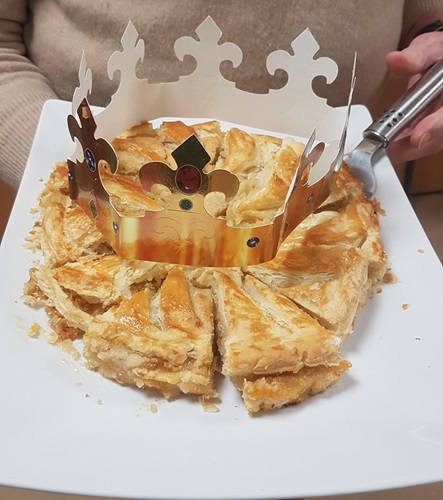
Afterwards, to rejuvenate our tired minds, Susan, Nikki, Margaret and Stella plied us with gingerbread biscuits, stollen, mince pies, almond cream tart*, biscuits and mulled wine. Never mind the questions, enjoy the sustenance. *Galette des rois, a popular French dessert for Epiphany Neil Hancox, 19 January 2024 | |||||||||||||||||||||||||||||||||||||||||||||||||||||||||||||||||||||||||
|
Go to 2023 Events. |




























 Finally
they were involved in the filming of Harry Potter and the Philosopher’s
Stone, though the car used, dare I say, was a Ford Anglia.
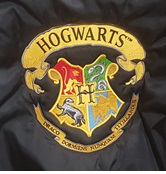
They did get a Hogwarts jacket at the end though, which John again showed to us.
Finally
they were involved in the filming of Harry Potter and the Philosopher’s
Stone, though the car used, dare I say, was a Ford Anglia.
They did get a Hogwarts jacket at the end though, which John again showed to us.