Argentan
Sint-Niklaas
Schongau
Lucca
Colmar
|
|
|
|
|
|
| Argentan |
Sint-Niklaas |
Schongau |
Lucca |
Colmar |
PAST EVENTS 2016 |
|||||||||||||||||||||||||||||||||||||||||||||||||||||||||||||||||||||
|
Go to 2017 Events or 2015 Events. See also the list of all Events since 2007, Future Events and the Newsletters. Many images can be enlarged by clicking on them.
|
|||||||||||||||||||||||||||||||||||||||||||||||||||||||||||||||||||||
Christmas LunchSunday 18 December 2016 - at The Cosener's House, Abbey Close
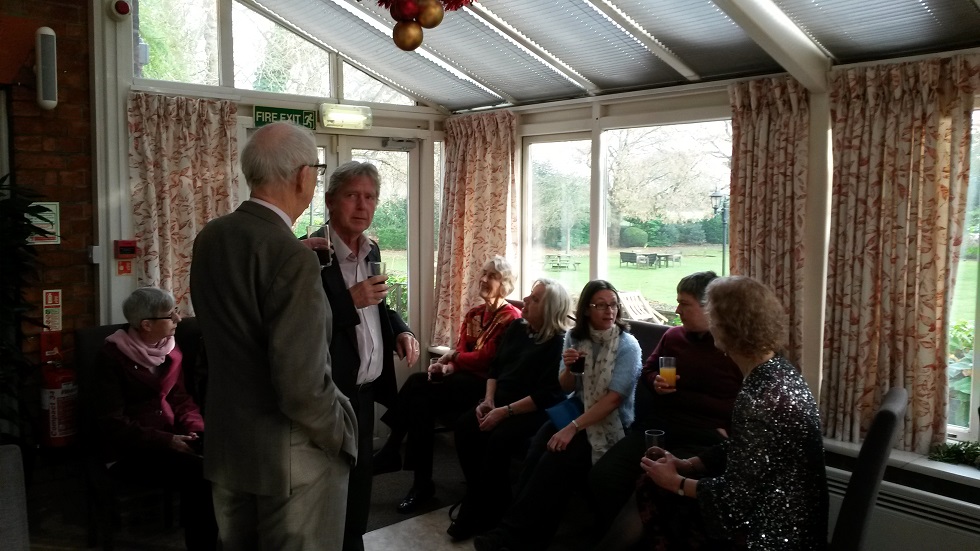
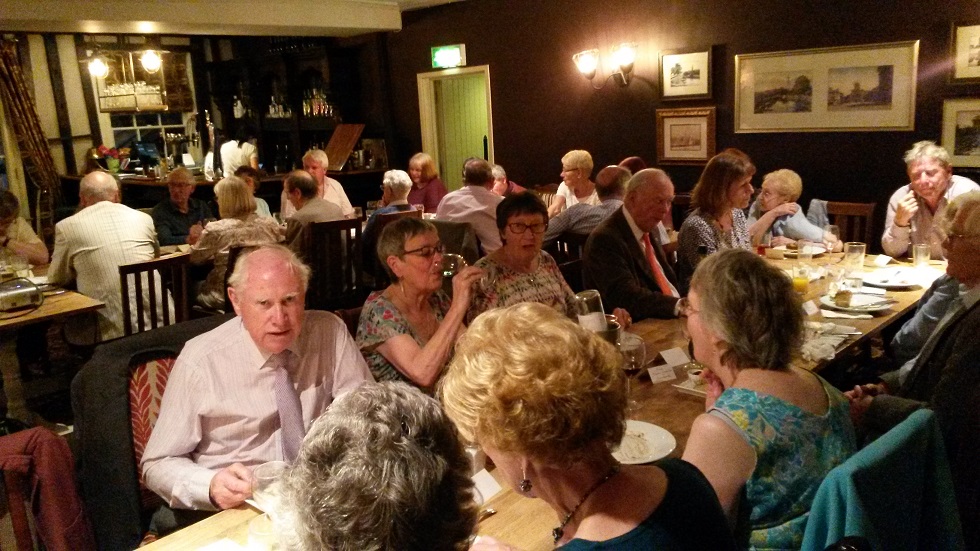
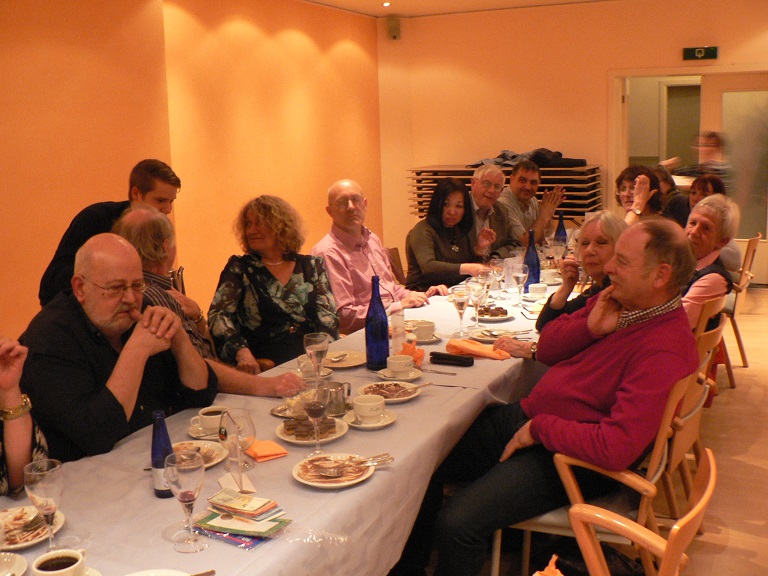
The annual Christmas lunch at The Cosener's House on Sunday December 18th was a great success. There were five tables each with the name of one of our twin towns. The food was excellent and people amused themselves with the traditional British Christmas activities such as opening Christmas crackers, laughing at the corny jokes, wearing paper hats, popping party poppers and firing balloon missiles across the room aiming at people sitting at the other tables. The usual raffle was well supported. Our Vice Chairman, Brian Read, thanked everyone for coming on behalf of our Chair, Stella, who was in Argentan, and especially thanked Mars & Marilyn Street for organising such an excellent event. Argentan Christmas Market16 - 18 December 2016
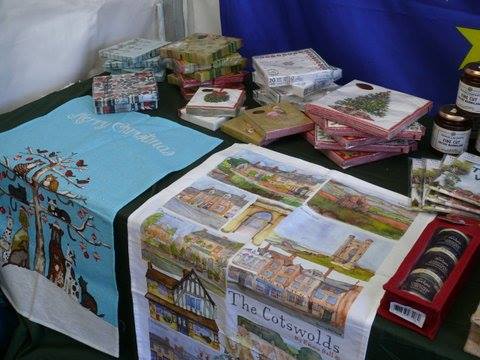
This year the Twinning Group in Argentan invited their twin towns to have a stall at their annual Christmas Market. The offer was taken up by their German and British twin towns so our Chair, Stella Carter, accompanied by Peter Dodd, set off for a weekend in Argentan with a car packed with Christmas things to sell. As Stella manages the Oxford Charity Christmas card shop we could take lots of Christmas cards and Christmas wrapping materials as well as traditional things like mincemeat and marmalade.
It was cold that weekend in Argentan but there was plenty of mulled wine and spiced cider around to keep out the cold. The French do not have a tradition of sending lots of Christmas cards like we do but many people had British connections and were pleased to be able to buy such good charity cards at a reasonable price. Almost everyone involved with twinning in Argentan visited our stall at some time during the weekend so it was good to be able to meet so many old friends like Pierre & Ionie Silliere as well as their new President of Twinning, Jean Paul Alexandre, who has some good ideas for strengthening our twinning links. (The photographs are taken from the Cercle Jumelage Europe Argentan Facebook page.) Evening Meeting - Stories of Lucca with Maria CurtoWednesday 16 November 2016 - at Preston Road Community Centre
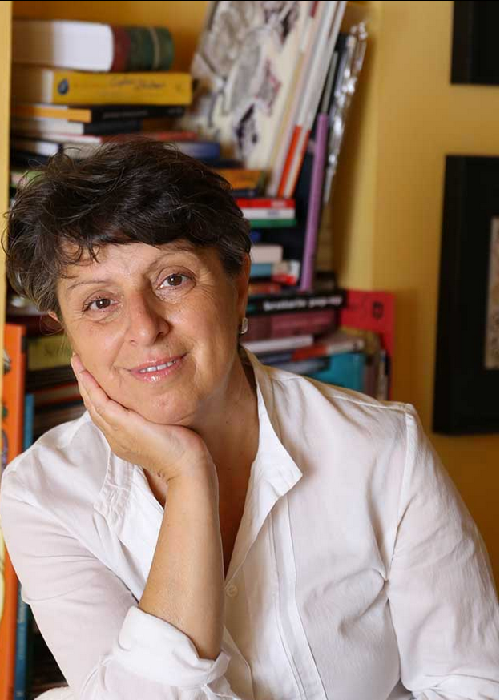
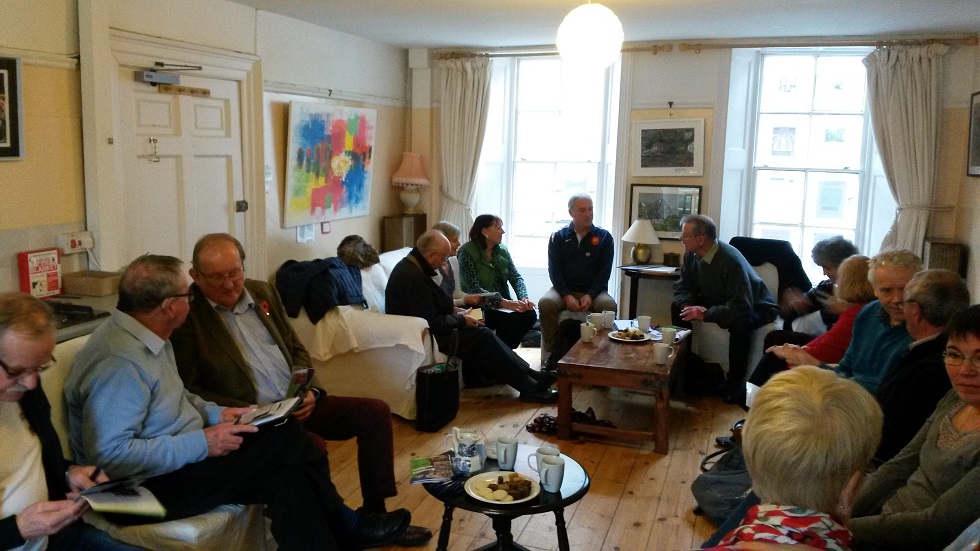
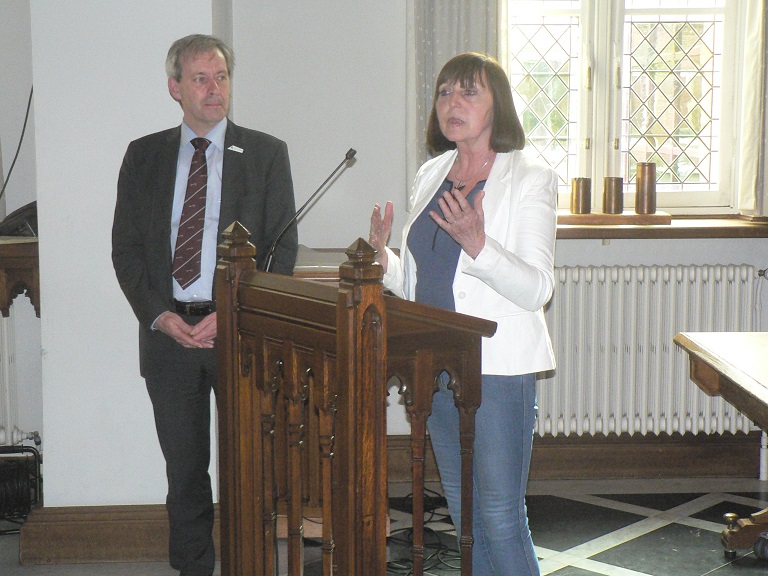
It was a special delight at our November meeting to have a visit and talk about her town from a resident of Lucca, Maria Curto. This attracted an even bigger attendance by our members than usual, some unexpected prospective new members, and a few Italian residents of the Abingdon area who we had not previously met. Brilliant.
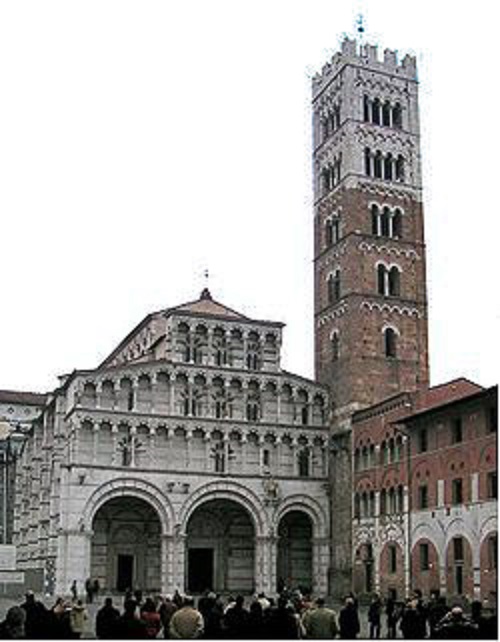
Our speaker gave us a wonderful taste of the fascinating stories she has uncovered, and of her craft as a lively and evocative story-teller, by telling us three stories, each of which had a medieval woman as its central character. The present-day Lucca is still a relatively unspoilt town, it’s almost traffic-free narrow streets within the medieval town walls and the ever-close proximity of the formidable town walls are just as they would have been in the medieval period. The first story, quite chillingly about the “crime”? of Lucrezia Buonvisi, and the twists and turns of her long protection from the town marshals by the popes whilst a refugee in a monastery, would be even easier to re-imagine and thrill to when related in the very streets in which it happened.
In conclusion, Maria said that she had visited Abingdon for town twinning on a number of occasions, and thought it a place full of historical locations and fascinating stories, and charmingly mused that Abingdon should awaken to its remarkable potential as a tourist town, in the way that Lucca had done so successfully. Remembrance CeremonySunday 13 November 2016 - 11am at The Square
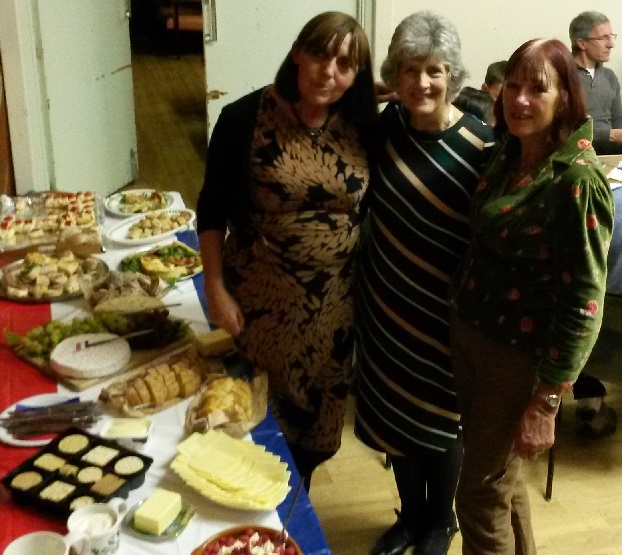
This year we invited Jean-Paul Alexandre, a representative from our twin town of Argentan, to join ADTTS in laying wreaths at the War Memorial. (See the brief video clip taken by Claude Diard.) Twinning Visit from Argentan10 - 14 November 2016 ADTTS welcomed fifteen visitors from Argentan over Remembrance weekend, marking the 60th anniversary of twining between the two towns. Apart from the important wreath laying ceremony, it was primarily a visit to make better contacts with various sports and other groups, including twinning. However, on the Saturday evening there was an opportunity for ADTTS members and others to meet our guests at a bring and share get together at Northcourt Centre.
We arrived on Friday morning and met Charlie Milward at home. We had a coffee together and Charlie made us discover mincemeat pie. Charlie has an beautiful oar and he teached us rowing but only virtually! Afterwards Peter Dodd picked up our group and we visited Oxford which is really a magnificent town full of history. Peter is a really good guide because he felt when we were tired or hungry or thirsty. I particularly appreciated the Bodleian Library with a great exposition of old treasures like the Magna Carta or the first page of Lewis Carol's 'Through the Looking Glass’. In Oxford we met the chairman of ADTTS Stella Carter who was in the town hall for a charity sale. We spoke about the things she could take for our next Christmas market in Argentan in December. Back to Abingdon on early evening in the Spread Eagle Pub where Richard Smart and his colleagues were waiting for us. We spend the evening with our hosts. On Saturday morning we had a meeting with Association of Abingdon at St Ethelwold’s House. It was very important for us to see Abingdonians who are involved in Sport and Culture and to speak with them about our cooperation in the future. Two Town Councillors were there and we had a very constructive conversation. Thank you to Rosemary and Ian Jardine for the organisation. The other French met the University of the Third Age. Other French people played Tennis in doubles in mixed teams. I heard the English-French young team won against the more experienced pair. Before we had a lunch in a pub, Susan and Brian Read let us visit the Church St Helen's and showed us the bell tower and explained how it's work with bell ringing. We were very impressed. Michael Matthews lead a tour of Abingdon. We visit first of all the site of Abingdon Abbey and afterwards the Alms houses. Michael told us about the history of the house and his management. A very old idea which survived down the centuries. On Saturday evening we had a meal with a buffet supper in the Northcourt Centre. We particularly enjoyed the Abingdonian beer and the exotic music of the Jumping Fleas. We had really a great evening! On Sunday 13th November was the Remembrance Day. We went to the civic memorial service and walked to the War Memorial for the wreath laying ceremony. It was something very emotional for us and we had been very strucked by the silence in the street. We couldn't go to the mayoral reception because the time was too short but we saw very quickly the secretary of ADTTS John Smith who organized our trip. Thank you John! We left at 12.00 for Portsmouth. Thanks to all members of ADTTS for their kindness and we hope we see you very soon in Argentan. Jean-Paul Alexandre – Cercle Jumelage Europe Argentan Evening Meeting - History of AbingdonWednesday 19 October 2016 - at Preston Road Community Centre
How it had started as a place, probably in the area of Boars Hill, near to Oxford, had then been moved to the side of the River Thames (which was beneficial to trading and communications), had been dominated by a big and wealthy abbey before King Henry 8th got rid of them, how by being close to Oxford we were involved in our civil war, how at one time Abingdon was the County Town of Berkshire (before boundary changes moved us into Oxfordshire), we were market town, had the MG car works, breweries and leather works, before becoming what we are today. A really interesting talk and a very enjoyable evening. Thanks to Anne Gould and everyone involved. AGM & Evening MeetingWednesday 21 September 2016 - at Preston Road Community Centre
The Secretary, John Smith, summarised the busy programme of events over the past year and outlined plans for the coming year. He reported that our letter reaffirming that despite Brexit the Society was still committed to full participation in twinning had been welcomed in responses received from all our twin towns. The treasurers, Rosemary and Ian Jardine, presented the accounts showing that, given the cessation in support from the Councils, a deficit was to be expected, though with a number of savings it was smaller this year. Our Chairman, Stella Carter, was abroad leading a group in the Danube Delta. She submitted a wide-ranging report on the good health of the Society, recognising the contributions of a number of key individuals to the activities of ADTTS, and also described how we interface in different ways with each of our twin towns. The officers and committee were re-elected with two main exceptions: Peter Dodd stood down as Vice Chairman to be replaced by Brian Read; John and Ann Prior had resigned - John was thanked for editing the Newsletter for the last four years and of course grateful thanks were expressed to both Ann and John for hosting Summer lunches in their beautiful garden. Phil Addison, previously co-opted, was confirmed as a committee member. Interests from other members in joining the committee would be welcomed. In other business, Ruth Sillitoe and Elizabeth Edgecombe, on behalf of the Church-in-Abingdon, reported on successful twinning visits in April when 14 came from Sint-Niklaas and then 19 went to Argentan. There was a long discussion on the parlous twinning situation with the Vale of White Horse Council, especially the embarrassment of January's Mayors' conference in Colmar, and of our efforts being made to try to improve matters. The AGM was followed by refreshments and socialising. Lucca Luminara13 September 2016 Friends Old and New in Lucca – A Visit for the Luminara
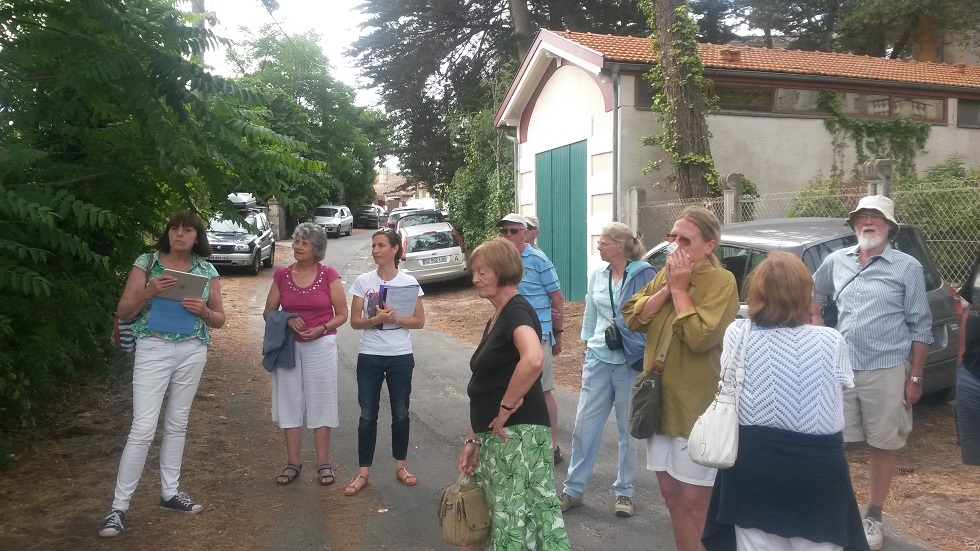
There were a number of visitors from Colmar whom we already knew and we were invited to join in any of the day time visits that they had planned, several of which Maria had been instrumental in arranging. We joined them in a visit to the beautiful Villa Torrigiani di Camigliano and its gardens just 10 km from Lucca, a walking tour inside the walls of Lucca and a visit to Pisa. This was followed by a wonderful lunch at a small restaurant midway between Pisa and Lucca. Our sincere thanks must go to David Mallen and everyone in the group who made us so welcome – thank you to friends we already knew and the new ones we have made! We look forward to meeting you again in the future.
Maria had arranged for us to meet with Linda and Sonia, both of whom were at the recent twinning weekend in July. Linda and her husband Roberto invited us to join them with their friends for a leisurely evening meal – excellent food, wine and company – thank you Linda and Roberto. They also took us to visit the hilltop village of Montecarlo and the small town of Altopascio, which is associated with pilgrims travelling on one of the routes to Santiago de Compestello.
We know Maria is looking forward to spending time in Abingdon and speaking at our evening meeting on 16 November – we believe she will talk a little about Lucca and also include some ‘story telling’ about interesting Lucchesi people! Our visit to Lucca really does reinforce the fact that anyone from our twinning association will be made really welcome at any time should they wish to travel independently rather than waiting for an official invitation. Thank you to everyone who made this a visit to remember. We look forward to the next time!! Rosemary & Ian Jardine Sint-Niklaas Balloon Festival2 - 4 September 2016
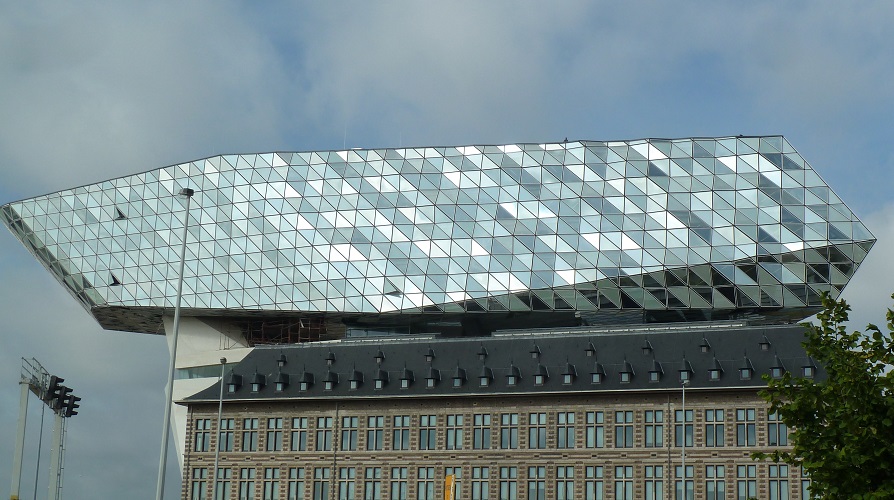
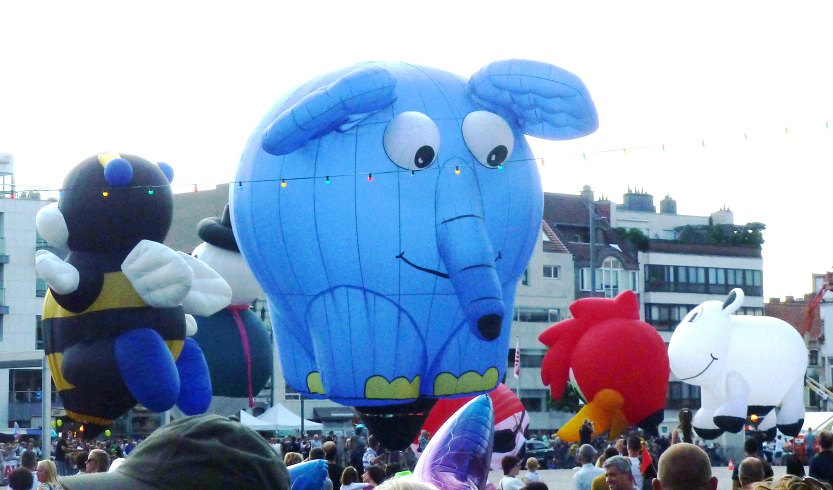
This year we visited the Balloon Festival in Sint-Niklaas for the second time. Last time we stayed in a hotel adjacent to the Grote Markt. This time that hotel was fully booked so we had booked an alternative hotel, which was half way between the railway station and the Grote Markt. The hotel was a little quirky (red and black throughout and what might be described as industrial chic) but nevertheless it was good and it was convenient for us. On Friday our twinning friends, who were to be our hosts for the weekend, took us to Antwerp. Here they showed not only the traditional Antwerp sights but also the new Museum ann de Stroom with its panoramic views of Antwerp and the Scheldt from its roof top and the new Zaha Hadid Antwerp Port building. The latter is a stunning building in the shape of a large car carrier ship built on top an existing building. Sint-Niklaas was hosting a twinning visit from Schongau over the weekend. On Saturday morning, we and our hosts met up with some of the twinners from Sint-Niklaas together with the Schongau visitors and their hosts. We not only renewed our acquaintance with Sint-Niklaas twinners we knew but also with six of the eight visitors from Schongau whom we also knew from their visits to Abingdon. Tripartite twinning in action! Unfortunately, “The Glow” did not take place on Friday night because of the weather. However the main balloon ‘take offs’ on Saturday afternoon were as spectacular as ever, as were the fireworks later that night. In fact, the fireworks seemed to go on longer and were more spectacular than the last time we visited. The Saturday afternoon started off with helium balloons taking off from the market square followed by a parade of smaller specially shaped ‘walking balloons’ walked round the market square by individuals each controlling one balloon. Then there followed the mass take-off of traditional hot air balloons from the market square. We lost count of the exact number after 45 balloons, all being inflated and taking off within an hour. This was followed by the take-off of the ‘special shapes’. These are specially shaped full size hot air balloons. Much of this is repeated on Sunday morning, but this year it was too windy for the balloons to take off. We took the opportunity to visit the Mercator museum, dedicated to the life and works of Mercator. For those who do not know who Mercator was, he was the cartographer who first developed a way of presenting the globe that is the earth realistically in two dimensions. Most people will have used maps or atlases that are based on his work. On Sunday afternoon, our hosts took us to visit two towns on the Scheldt, Termse and Rupelmonde. The latter contains the tower where Mercator was imprisoned for heresy. We spent Monday visiting Ghent with our hosts before returning home on Tuesday. For anyone who has not been to the festival it is well worth a visit. We had an excellent time in Sint-Nikaas that would not have happened without twinning. Finally we give a special thanks (again) to our hosts. Mars and Marilyn Street Drayton Twinning Visit to Lesparre-Médoc21 - 26 July 2016
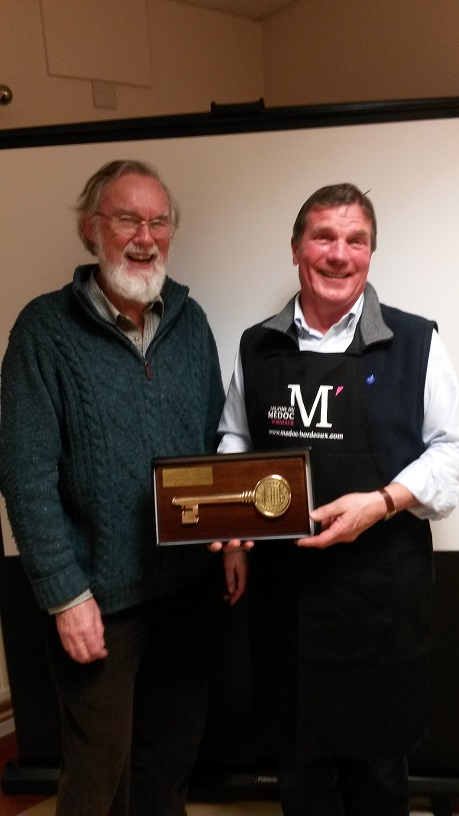
Following on from January's Evening Meeting, Drayton Twinning Society generously invited members of ADTTS to join them in their twinning visit this year to Lesparre-Médoc, near Bordeaux. Thus three couples from ADTTS, Stella & Howard Carter, Gwyneth & John Goss and Susan & Brian Read, took up this offer to experience a new twin town in a lovely part of France. They joined the party of established twinners from Drayton, Ruth & Stephen Fearnley, Jayne & Maurice Castle and Bob Matthews. Unfortunately on this occasion Barbara & Michael Bell were unable to participate.
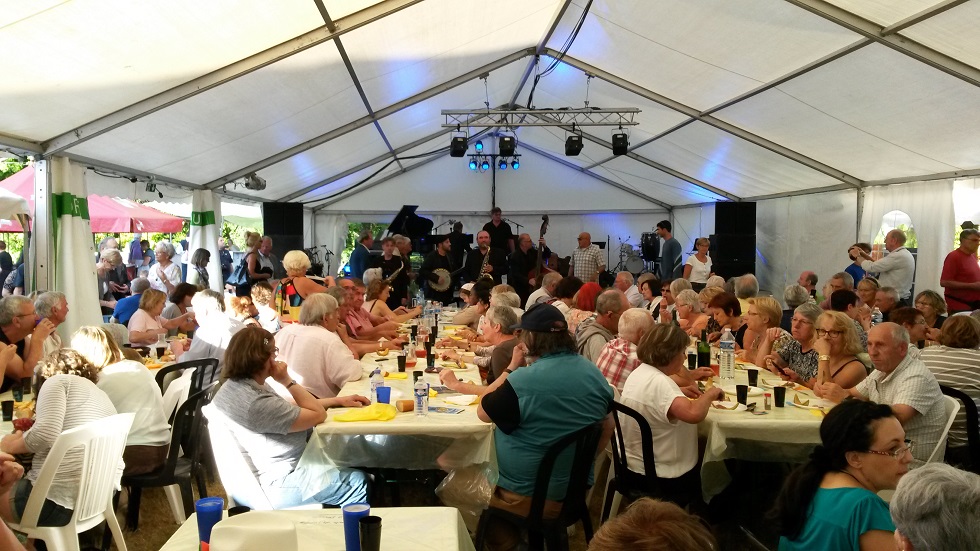
As one might anticipate, a full programme of activities filled the five-night visit. This included a welcome reception in the town hall from the Mayor, a fascinating guided tour of a workshop making wine barrels (a very important local industry!), an evening at the town's jazz festival, a coach trip to Castillon for a vast son et lumière depicting the battle that ended the hundred years' war (and the departure of the British from Aquitaine), a grand seventieth birthday party with sheep roast, an evening picnic at an oyster fishing cabin at Port de Goulee followed by an excellent view of the annual firework display and, on the last day, a drive to the Atlantic coast at Lacanau Océan for a guided tour of the distinctive architecture, followed by wine tasting and a picnic amongst the trees. The weekend concluded with a farewell dinner dance.
Lesparre is right in the Médoc and of course much splendid red wine was served at every opportunity. Certainly the French hospitality was wonderful in the best tradition of twinning - a truly classic visit! Annual Garden PartySunday 3 July 2016 - Willows, Faringdon Road, Shippon
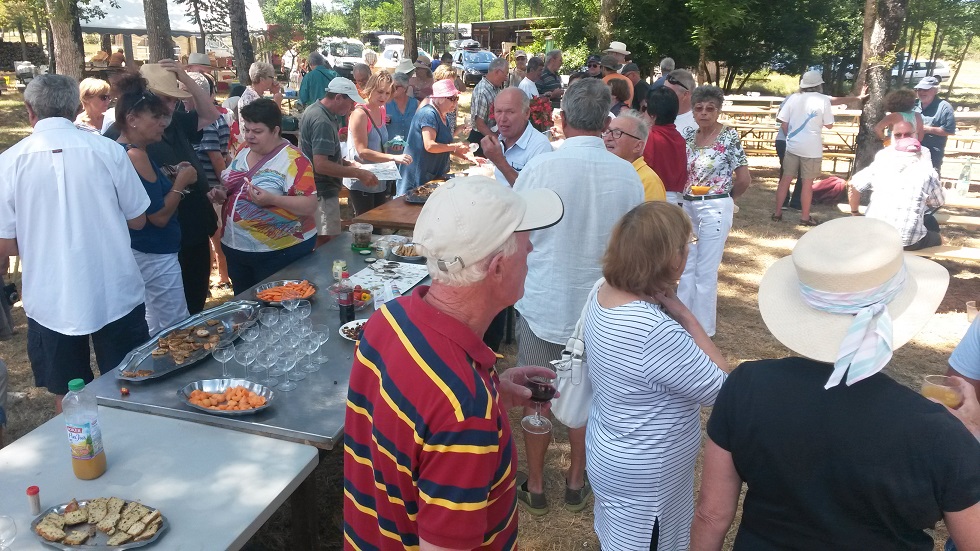
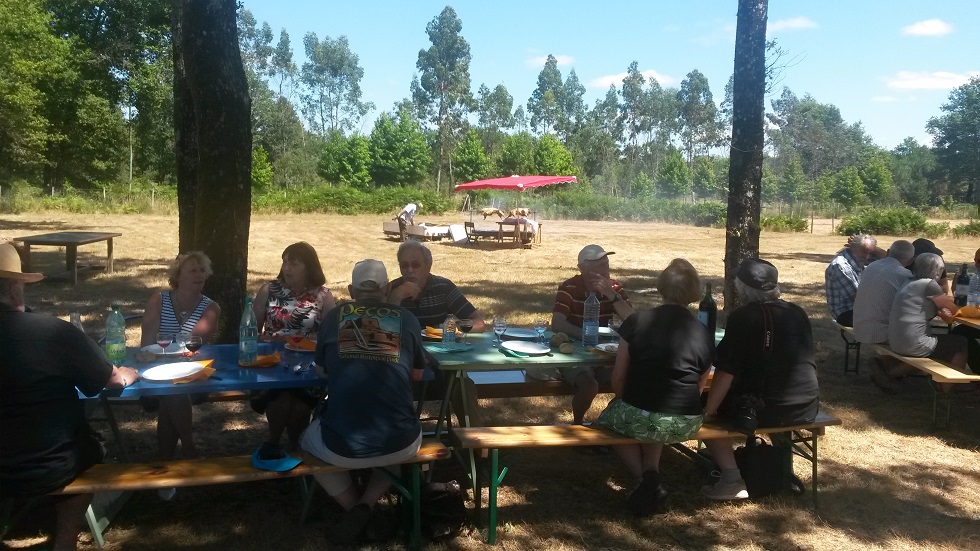
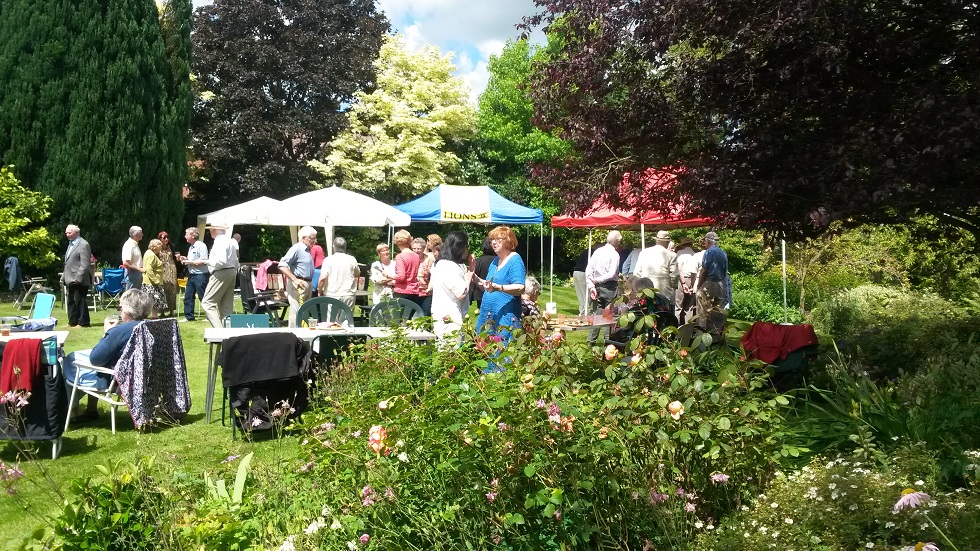
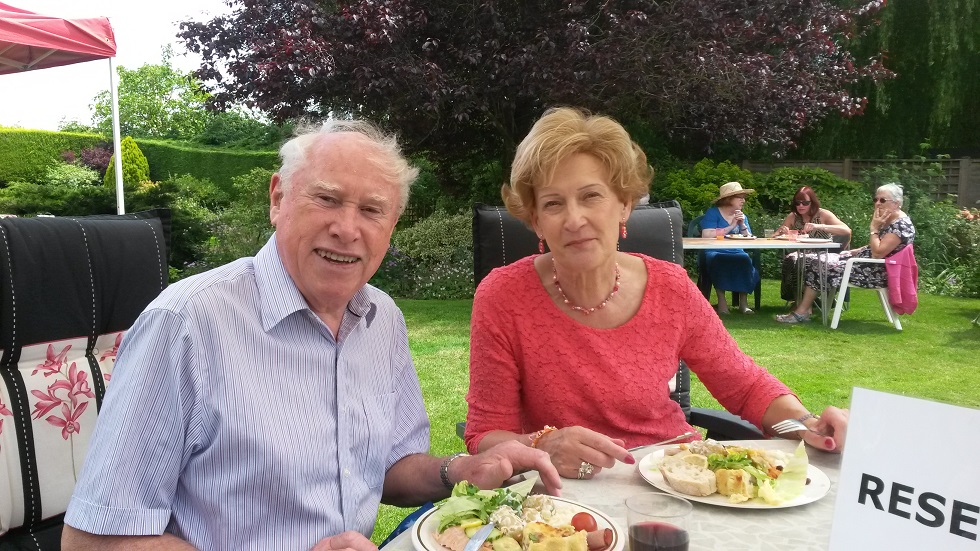
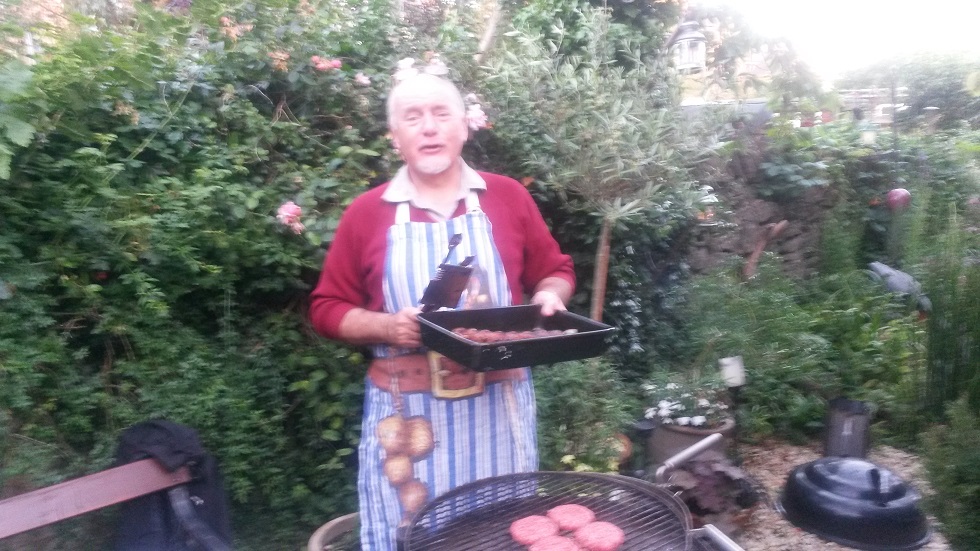
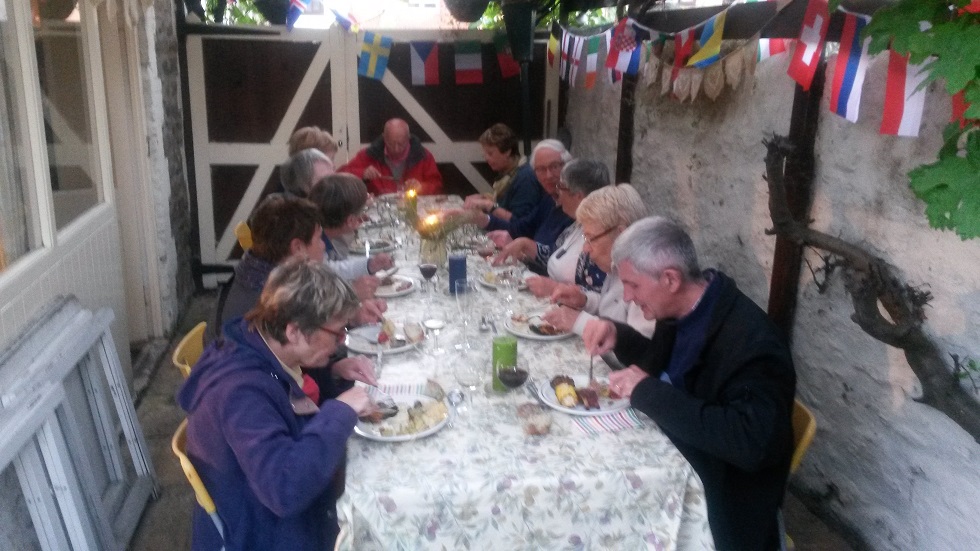
Thank you to John and Ann Prior for hosting the Garden Party again this year. After weeks of poor weather we were blessed with beautiful sunshine which allowed us to enjoy the lovely setting. Thank you to everyone who contributed with setting up the gazebos and the tables.
The event was well attended by Abingdon Society members and we also welcomed a total of fourteen guests from four of our twin towns Colmar, Lucca, Schongau and St-Niklaas. It was a pleasure to meet up with them all to renew friendships and in some cases meeting new friends. They enjoyed tasting the various dishes on offer and judging by their appetite for second helpings realised that the English are also good cooks! Thank you to everyone who came along and made this an enjoyable afternoon. Gwyneth Goss Abingdon Twinning Weekend30 June - 4 July 2016 The members of Abingdon Twinning Society invited up to four visitors from each of our twin towns to spend a long weekend with us here in Abingdon-on-Thames. We welcomed Jean-Paul & Lucile Loison and Phillipe & Francine Lecouturier from Colmar, Linda Bussanich and Sonia Mancini from Lucca, Uschi Ritter, Gabriele Kraus, Vera Lucas and Maria Skopal from Schongau and Marcel van Lomberghen & Irène Nys, Marie-Loise Viegels and Lieven Hofman from Sint-Niklaas. Below are reports of the weekend from three of the visitors.
I woke up this morning and, as I saw the pictures on my camera, I realised my beautiful dream had been real. I met some beautiful people with the hart on the right place. We were welcomed like kings, or even better, like friends you share almost everything with. Abingdon is a lovely town, peaceful, not too busy, and up-to-date without loosing the link with the past. It seemed like half of the town was up in St-Helens tower to let the bells ring their most beautiful songs for us. Of course, big- brother-town next door, is of another level. Oxford is a super-city. By a smoothly streaming river Thames we entered the city. After a family picnic on the university lawn, we visited the busy, high culture, town. On Sunday we were invited for a garden party in a most beautiful garden in Abingdon. But to everything comes an end. A fantastic evening with a twinning competition made us all looser and winner. We went to Abingdon as strangers but left it as friends. No "leave" can take us our wish to plan a "stay" again. Thank you all, friends, for your harts. Lieven Hofman (Sint-Niklaas)
Dear All, first I want to say again thank to all of You. You have done a very good job. It was a wonderful twinning weekend! Everything was so well organized and the excursions were beautiful. I liked especially the boat-trip to Oxford. But also all other events were very nice, as there was for example the sight-seeing tour in Abingdon, the afternoon in Oxford, that everybody could spend in his own way or the trip to Dorchester with the possibility for a walk. And I don't know, how You managed that with the weather. But it was great. No rain all weekend. I even got a little sunburn on sunday. I am so impressed of your hospitality and enjoyed to see, how people are living in England. It is not naturally to open your house for strangers, give them a bed and feed them. And I admit, that the food in England nowadays is much better then in earlier times. We had so delicious meals! The barbecue on friday evening, the picnic in Oxford with view on the Christ Church College at saturday noon and the big garden party on sunday. And by the way you can practice your English, meet interesting people from other countries (Italy, France and Belgium) and learn a lot about the english culture and everyday-life. Also the actual political situation was a exciting topic ("Brexit"). The climax of the twinning weekend: the great farewell-party at sunday evening. I played games, witch I hadn't played since years and, what was the best: my partner Lieven and I won a lot of the matches, table-tennis, darts, table-football, boules. Only at the sausage tasting I failed. From six possibilities I missed five! But that didn't narrow the fun. So you see: it was a extremely fine weekend with exceptional friendly hosts in a beautiful landscape and I enjoyed it very much. I am looking forward to the next meeting with all of You, in Abingdon, in Schongau or at another place. With kind regards
Thursday 30th June Thursday morning at 4:30 (our time) I left home. Marcel, our driver, and his wife Irène picked me up by car and then we drove to Lieven’s place. Four persons from Belgium who wanted to visit Abingdon. We drove to Calais. From Calais to Dover by the steamer. And from Dover to Abingdon. Once there were welcomed by our host families. My host family were Ian and Angela Waterhouse. Very warm hearted and friendly people We had our evening meal by our hosts. At 20:00 we met the other guests and their hosts in the pub 'The White Horse'. Friday 1st July In the morning we were getting to know Abingdon better. We met each other at 10:00 at the County Hall for a guided tour. We had our lunch at 35 Ock street where I met my pen pal Jane. I was pleasantly surprised. In the afternoon we visited Dorchester co-ordinated by Peter Dodd. This was the region where Inspector Morse was filmed. A beautiful landscape. In the evening there was a barbecue for the guests and hosts at Stella Carter’s. It was very cozy there. Saturday 2nd July We made a boat trip to Oxford co-ordinated by Nikki Henton. At noon we had a picnic in Christ Church Meadow. Then after our picnic we visited Oxford. Ian Jardine guided one group. Gloria our group (Marcel, Irène and me). We chose for a walking tour of the town and the university. Oxford is a very beautiful city with historical values. In the evening we had dinner with my hosts. Celia and Angela made very delicious curries and crumble. I like it! Two guests from Germany were also present. Sunday 3rd July In the morning we went to church Angela and me. At 1:00 pm we had an annual garden party. It was be held in John Prior’s and Ann's beautiful garden in Shippon. Lunch was prepared by ADTTS. At the evening we had a farewell supper for guests and hosts with games and Sausage tasting competition at Richard Smart’s house. Monday 4th July Farewell I had the opportunity to meet people from Shongau, Lucca and Colmar and their hosts. For me a truly unforgettable weekend. I met all these friendly warm hearted people. Finally I sincerely thank the ADTTS, my hosts, Angela and Ian , Stella, Celia , Gloria , Ian Jardine, and all the others. Marie-Louise Vlegels (Sint-Niklaas) Informal Social EveningWednesday 15 June 2016 - 89 Pinnocks Way, Botley, Oxford, OX2 9DE This year the Wednesday evening programme was extended into June with an informal social evening and what a good idea that proved to be. Nikki Henton opened up her lovely and interesting garden for some 30 of us to enjoy. The torrential rain earlier that day had made it a little soggy underfoot but the wonderful variety of plants were in great condition and the stream at the top of her garden was free flowing. So with great snacks and wine to add to convivial company, we all had a splendid time. The late leavers were even treated to an extra bonus of seeing a family of badgers come into the garden. Nikki – Many Thanks Rosemary & Ian Jardine Evening Meeting - Food & Drink of the Twin TownsWednesday 18 May 2016 - Preston Road Community Centre Our May meeting, overseen by Gloria Tolputt, had as its theme, “Food and Drink of our Twin Towns”. A number of recent meetings had a Lucca theme, so this meeting focussed on France, Germany, and Belgium.
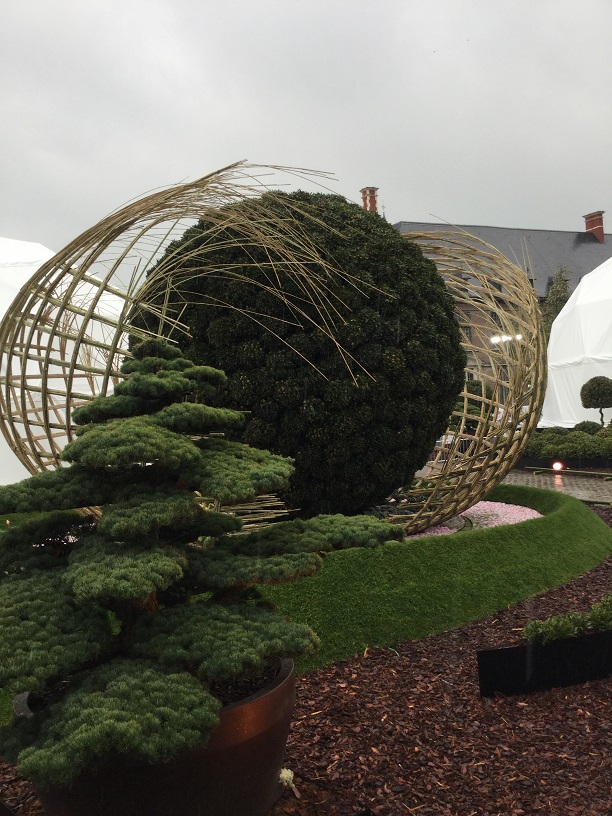
This became even more amusing as Gloria, still with her back turned to the worried face at the service hatch, invited Susan to come out of the kitchen and explain the origin and reason for choosing the particular dish she had cooked (Zwiebelkuchen), before it was served! The situation was saved by Gloria, Nikki and others serving out the food while Susan explained. Many years ago she had moved to Germany at short notice so that her husband could take up a job there, but she could not speak any German. However, on arrival, they saw a free-of-charge cookery course offered by the Natural Gas Company. She joined the course as her first step in learning German. The title of the course was “Kochen mit Gas” (cooking with gas). However, her “cooking with gas” at our meeting had meant it was ready sooner than required! The first recipe she learned in German? (She brought along a copy of the Zwiebelkuchen recipe to show us). Whilst the food was served, we viewed a slide compilation of scenes at our various twin towns, including Lucca and Colmar. We tasted a Bavarian smoked cheese with ham inserts, and salami, both on very dark bread (almost Schwarzbrot) and of course the not-to-be missed gherkins, accompanied by excellent Bavarian beer. Short talks were given by our Secretary, John Smith, with beautiful slides of Bavaria. Treasurer Ian Jardine related the very moving true story from Alsace of Suzanne, about reconciliation and re-finding long-lost relatives. Accompanied by servings of French red wine or Normandy cider, Richard Smart commented on slides from his many visits to Argentan on Town and Schools Twinning, including some of the coastal defences and, in particular, the floating harbour which, it transpired, our chairman's uncle had been involved in designing (filling his home bath-tub with models), and another member whose relative had driven lorries along the floating harbour, reporting that even just the lorry had made the floating harbour move simultaneously both up and down, and side to side. It’s a small world! The last presentation was by our chairman Stella who, again with slide accompaniment, told us about the April twinning visit to St Niklaas, taking in the largest Japanese garden in Europe at Hasselt, the visit to the Keukenhof bulb gardens and Flower Parade at Lisse, and the bi-annual Floralien in Ghent. Our excitement, whilst at Floralien, was to see so many huge examples of the installations of Sint-Niklaas' world-renowned floral art designer, Daniel Ost. A very full and entertaining evening enjoyed by an excellent turnout of members, and four prospective new members. Philip Addison Europe Day DinnerMonday 9 May 2016 - The Kings Head & Bell, 10 East St Helen's Street As soon as I walked into the bar of the King’s Head and Bell, I was sent out! That’s not as bad as it seems though, as I was directed across the passage and up the stairs into the Function Room, where tables were laid, and a barmaid was present.
We began, of course, with glasses raised in a toast to the day, and to our many friends in our twin societies in Europe. Then the food arrived! I confess that I was overwhelmed by my whole, delicious, runny Camembert (which friends managed to polish off when I had eaten enough) but all plates of food looked very appetising. I can only speak for myself, but I thought it was a nice change to be served home-cooked food, and our compliments go to the kitchen. Thanks also to Mars for the paperwork, and Gloria for a really good evening. Sue Hodgson Gardens Trip to Sint-Niklaas21 - 25 April 2016 A party of ADTTS members went on a trip by coach to our twin town of Sint-Niklaas in Flanders, with a choice of staying with a local family or in the central Ibis hotel. The programme featured visits to interesting gardens, including the famous Keukenhof spring garden in Holland.
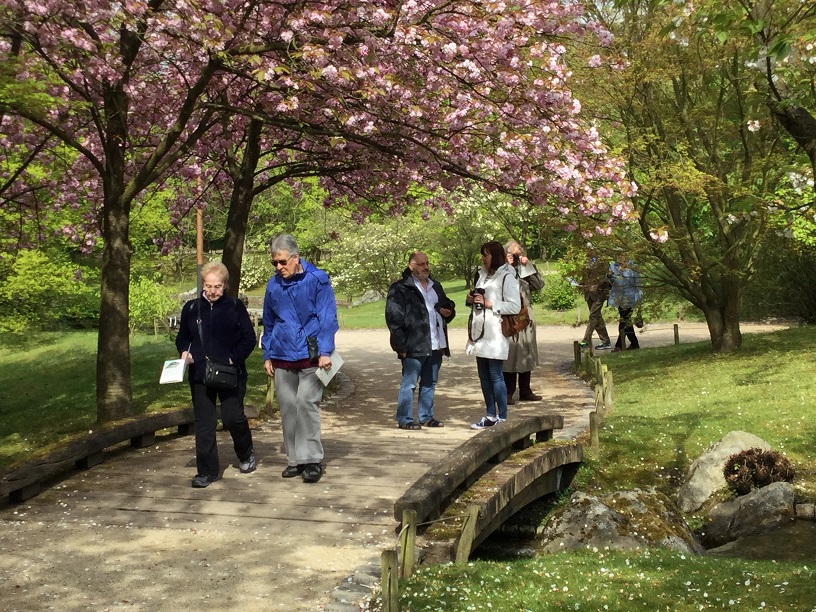
The April visit to Sint-Niklaas, our twin town in Belgium, packed a lot into five days – Thursday 21st to Monday 25th. An early start from Abingdon and a crossing via the Channel tunnel allowed us a stop in Bruges en route to Sint-Niklaas. John, our skilful driver throughout the stay, managed to negotiate a major street closure to get our coach to the scheduled stopping place from which a pleasant walk over canals and through parkland brings you into the City. Few managed to reach the Grote Markt and its famous Belfry, more than 1.6 km away, but there are fine buildings, and attractive shops and cafes, in all parts of Bruges. Daily Telegraph readers had only a week earlier voted it amongst the world’s top 50 cities to visit in a list including London but excluding Oxford. “That’s the city with the big Market Place”, said Martin Bond, former EU Head of Information in London, when I mentioned our visit to him a few days after our return. The Grote Markt is indeed the largest in Europe, and that’s where we were met by our hosts, in front of the imposing Town Hall. Those not staying with host families had only a short walk to the Ibis Hotel on the corner of Hemelaerstraat. A rather more formal reception by the Mayor of Sint-Niklaas was scheduled for 4 pm on the Friday, the earlier part of the day being taken up with a visit to Hasselt, capital of the neighbouring province of Limburg. As a result of the friendship built up between Hasselt and Itami, in Japan, the city has a splendid Japanese Garden, the largest in Europe. It adjoins the city’s Kapermolen Park, a green wedge stretching right into the city centre. The Garden was created to give visitors the opportunity to become acquainted with Japanese culture and customs. A guided walk through it includes streams, a waterfall, a zig-zag bridge, a beach, a Shinto shrine, a Ceremony House, a Tea House (but no tea!) and a great deal of symbolism. Our visit was made more special by the abundant cherry blossom. Before returning to Sint-Niklaas we were able to spend an hour or two in Hasselt, a fine city which boasts a museum devoted to Jenever, the very various gin favoured through the Low Countries. In one of the many cafes I was able to sample a Hasselt Koffie, generously spiked with the stuff and served in a special glass, topped with cream. Back in Sint-Niklaas the Mayor received us in the Town Hall, told us of city and its growth as a trading place between Ghent and Antwerp. Because of his interest in history, Stella presented him with a tie from the Ashmolean Museum. It was good to see so many of our hosts gathered in the Town Hall for this occasion. The Saturday, for which we had a planned trip into Holland to visit the Keukenhof and its bulbfields, got off to a disastrous start. Making an 8.30 am departure, we found ourselves six hours later still short of the coach park at the Keukenhof. As our coach inched towards it, the road was lined with barriers behind which crowds several deep awaited the passage of the Flower Parade from Nordwijk to Haarlem. It’s fair to say that part of our delay was just before crossing into Holland, when the Belgian Police, doing a spot check on coaches, decided ours was not carrying some of the documentation required. After about an hour of telephoning and exchanges of e-mails (helped by Luc, one of our accompanying hosts), we were allowed to proceed. The Keukenhof is always crowded during its relatively short season, even more so on the day of the Flower Parade. Some of us were able to watch the Parade pass, others went straight into the Keukenhof. Magnificently inventive plantings and displays as usual. It was always a place to photograph and be photographed in – and now that no-one is without a camera of some sort, to say nothing of selfie-sticks, it does sometimes get in the way of enjoying the flowers themselves. I was especially struck by some displays of exotic varieties of narcissus, some resembling roses in shape and colour. Our journey back into Belgium, helped by John’s navigation of a relatively uncrowded route away from the Keukenhof, took only a fraction of the time taken to reach it. The main day for Sint-Niklaas was the Sunday. First stop was the Mercator Museum, to which we were given a really informative introduction, including one of the best explanations of projections and triangulation that I have ever heard. The 16th-century cartographer, mathematician and theologian Gerardus Mercator was born at Rupelmonde, not many miles from Sint-Niklaas. For all that he produced the globes, atlases and maps that made such a difference to world navigation, Mercator barely travelled outside Flanders and the Rhineland; it is said that he never saw the sea. Of course Antwerp, where he spent some of his early years, was a cosmopolitan city and port trading with all parts of the known world. In the afternoon, Kris van der Coelden, A Sint-Niklaas councillor, took some of us on a guided walk around the city’s Green spaces. The first of these was a large garden behind an impressive house, The Salons, given to the city by a wealthy industrialist and now the Stedelijke Museum. Our subsequent walk took us through some streets of handsome 19th and early 20th-century houses, through a green area dotted with clinics, many specialising in mental health care, and the Vidtspark, perhaps the city’s best-known with its moated Walburg castle. Our return to the Grote Markt went past the restaurant where, that evening, we assembled for a farewell dinner with our hosts. A touch of comedy was provided by a presentation to John, our driver, of a copy of the certificate Belgian police had claimed he should have been carrying and a scale model of a police car, complete with flashing blue light. Throughout our stay, Siegfried Watershoot was our ever-present host. For those of us not visiting the Floralien, “a dynamic and interesting extravaganza” taking place at four locations in Ghent, where we stopped on our return journey to the Channel Tunnel, he provided a short guided tour (between showers) and found us a restaurant where we could shelter and enjoy local specialities. I’m not sure where Ghent is twinned with, but wherever it is it’s a lucky city. Still, we don’t do so badly, as an ex-county town, being twinned with a Flanders city as interesting as Sint-Niklaas and peopled with such welcoming hosts. Roger Bush Evening Meeting - Vale Twinning QuizWednesday 20 April 2016 - 7.30 for 8pm at Preston Road Community Centre
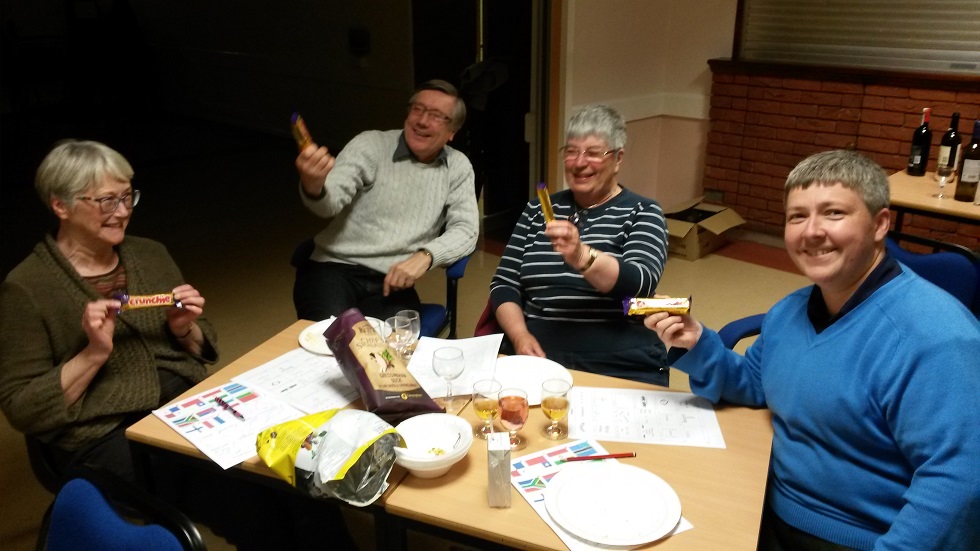
With a trip to Sint Niklaas leaving early the next day and a Church twinning visit to Argentan leaving even earlier there were only four teams of keen quizzers at the ADTTS Quiz night with a difference on Wednesday 20th April. Quiz master , Peter Dodd, started with a first round asking people to identify countries by shape and by flag which tested geographical knowledge. This was followed by the first tasting round when the teams were given five different varieties of potato crisp to identify. None of the teams identified the duck with plum sauce flavoured crisps or even the lobster cocktail variety so more crisp eating is necessary if the top score of 1 out of 5 is to bettered on a future occasion. The teams did better on the next round of questions about our twin Abingdon and District Twin Towns Society towns but were again shown up by their inability to identify the flavoured ciders in the second tasting round. No one could recognise peach cider or toffee apple flavoured cider. The round of dingbats was welcomed by some team members who soon worked out the intriguing puzzles although some people were new to these and were not so sure. The evening finished with some French bread and cheese which was enjoyed by all. Peter Dodd Film Show - "Emil and the Detectives"Thursday 24 March 2016 - at the Health and Wellbeing Centre, Audlett Drive, Abingdon OX14 3GD This was the annual joint meeting with ABCD, the local film society. The featured film was "Emil and the Detectives" (Emil und die Detektive) - the film of a novel for children first published in 1929. The book's author was Erich Kästner, who had the honour of having his books burnt by the Nazis. The story has become a firm international favourite, with a very successful recent National Theatre stage adaptation. We watched the first film version. This was made in Germany in 1931 (an early sound film), with English subtitles. "When young Emil is sent to Berlin by his mother, the money he is carrying to give to his grandmother is stolen by a sinister man on the train. Once in Berlin, Emil follows the thief and enlists the help of a gang of youngsters 'the detectives' to help retrieve the stolen money." "This classic 1931 German adaptation of Eric Kästner's much-loved children's book was written by Kästner himself in collaboration with the legendary Billy Wilder (Sunset Boulevard, The Apartment) and an uncredited Emeric Pressburger (A Matter of Life and Death, Red Shoes). Emil and the Detectives was one of the first German sound films, and provides a fascinating glimpse of Berlin before Nazism and the Second World War." (Review) "It is impossible for us to be like children again but we can try and prevent children from becoming like us" – Erich Kästner Refreshments (bread, cheese and bottles of wine we brought with us) were available beforehand and socialising continued after the film. Altogether, it was a very enjoyable evening! Evening Meeting - Giacomo Puccini (1853 - 1924)Wednesday 16 March 2016 - at Preston Road Community Centre
Puccini was born in Lucca, twinned with Abingdon and a great favourite with those who have visited it. He was the fifth generation of a family of musicians in the city, most of whom were composers of church music and organists. However, when Giacomo was 18, he visited Pisa and heard Verdi’s Aida. That convinced him he was destined to be an opera composer. His first work was Le Villi – the legend of brides, deserted by their lovers and turned into spectres dancing their loved ones to death – staged in Milan in 1884 to great acclaim. He was then hailed as 'the heir to Verdi'. David Shaw then concentrated on four of Puccini’s most popular works: Madama Butterfly (1904), Turandot (1926), which was unfinished at his death, La bohème (1896) and Tosca (1900). His popularity was such that all the greatest singers of their day performed his work. To illustrate this (with the assistance of Philip Addison at the CD player), we heard Renata Tebaldi as Butterfly, Eva Turner in Turandot, Jussi Bjorling as Rodolfo in La bohème, and finally Maria Callas as Tosca. Puccini’s wonderful sense of melody and colourful orchestration have ensured his enduring success. David Shaw’s knowledge and enthusiasm was supplemented by a fund of personal recollection. At the Royal College of Music, for instance, he recalled hearing down one of its corridors the resounding voice of Dame Eva Turner recommending 'DEEP BREATHING!' to some pupil. A thoroughly enjoyable evening. Helen Bush Theatre Visit - ToscaFriday 26 February 2016 - at the New Theatre, Oxford Our chairman organised a party from ADTTS to see Ellen Kent's production of Puccini's opera Tosca at the New Theatre in Oxford. Before the performance nine members enjoyed supper together in an Italian restaurant. Evening Meeting - ArgentanWednesday 17 February 2016 - at Preston Road Community Centre
The two centre photographs are from a tour of Argentan led by Mark Lane on our visit to Argentan in October 2012. A Brief History of Argentan 500 - 2016 CE Mark Lane, a former museum director in Texas, who now lives in Argentan with his wife Sandi, gave a very interesting illustrated history of Argentan at the February meeting. The Lanes, who retired early, wanted to live in France and firstly acted as (unpaid) guardians of the nearby Château de la Motte before buying a house in Argentan itself. Although there is no evidence of a settlement before the 11th century, the church probably dates from the 7th century and there were a few Roman villas in the area. The origin of the name possible indicates there was a silver market there. Henry II (12th century) established a series of forts (Caen, Falaise, Argentan, Alençon and Le Mans) each a day’s march apart. Henry probably also brought the Arthurian legend to the area. His mother, Matilda, spent time in Argentan while trying to gain the English throne. The area round Argentan had a good hunting forest nearby which was favoured by English kings. The town was also on the pilgrim’s route from Paris to Mont St Michel. Dukes of Alençon liked to live there and Argentan’s current Palais de Justice was the ducal home. Argentan suffered in the 100 Years’ War (14th-15th centuries), and also from the Black Death (mid 14th century) during which the town lost around 50% of its inhabitants. Mark gave an interesting account of the dual between Jacques le Gris and Jean de Carrouges (1386) and suggested it would make a wonderful film! An important date, which all French children learn, is 1453, which saw the invention of the printing press, the end of the 100 Years’ War and the capture of Constantinople. In the 17th century Louis XIV gave the town a licence to make lace. This brought some prosperity, probably the best they had had. Towards the end of WW2, after the D-Day landings, the town was 95% destroyed. Nearby, the Germans were trapped between the Americans to the south and the British, Canadian and Poles in the north (Falaise pocket). The Germans lost 50,000 men and 2000 horses. It is not generally known that the Germans used 60% horses at beginning and 95% at end of war for transport. Argentan was rebuilt after WW2. Its population has stayed relatively stable at around 15,000, despite loss of traditional industry. The main industries now are dairy and trotting horses. This was a very comprehensive overview of Argentan. I especially liked the way Mark illustrated the talk, visually and with humour; but most of all I was fascinated by a view of English and French history from an American perspective! The evening finished with a sampling of Normandy cheeses and Calvados – both the apple and pear varieties. Margaret Hancox Colmar Weekend - Unterlinden Museum Reopens21 - 24 January 2016
This was a very important occasion for the town. Representatives from Colmar's twin towns were invited to participate in the celebrations. ADTTS was represented in a meeting with the other twinning societies by our chairman, Stella Carter, accompanied by husband Howard. All the mayors of Colmar's twins were officially invited. At the conference, there were presentations from Eisenstadt (Austria), Gyor (Hungary), Lucca (Italy), Princeton (New Jersey, USA), Schongau (Germany) and Sint-Niklaas (Belgium) about proposals for future twinning activities. Embarrassingly absent was any UK official - the Chairman of the Vale of White Horse had been invited but neither he, nor a deputy, showed up.
Photos: View of Colmar, Hoar frost on the vines, Stella by the Vale sign, Colmar and Italian friends raising their glasses, Belgian contingent by the plaque & Ingrid Schupp (Schongau) and Howard. Evening Meeting - Lesparre-MédocWednesday 20 January 2016 - at Preston Road Community Centre
To learn about Lesparre and the link with Drayton, we invited Michael Bell and Stephen Fearnley along for the evening to tell us about their twinning activities.
Michael Bell first went to the Médoc in 1975, fell in love with the area and visited many times before setting up a twinning link with Drayton. His talk, together with Stephen Fernley, covered the history of Lesparre twinning and what they get up to on their visits there. The Médoc is the peninsula north of Bordeaux with gorgeous sandy beaches in the west, world famous vineyards on the banks of the Gironde and the largest European man made forest known as the Landes in between. The forest was planted to try to stabilise the sandy terrain which could shift alarmingly. The church at Soulac was buried during a sandstorm in the middle ages and for centuries all that could be seen was the cross which people used to tether their horses. It has now been dug out and looks like it lies in a huge crater. Eating, drinking and socialising seem to be the main activities of Lesparre twinners and I am not surprised. You don’t have to go far to find excellent wine, cider, truffles, oysters, seafood, mushrooms, cognac and pate to name but a few of the delights of the area. We saw footage of markets and wine festivals in Soulac and Lesparre as well as visits to lighthouses, vineyards, wine museums, naturist and conventional beaches and lakes. The Atlantic coast is fantastic for swimming and surfing and the climate makes it an ideal holiday destination. It is an area with a rich and varied history involving Eleanor of Aquitaine, Henry 2 of England, the 100 year war and, of course World War 2. Royan, on the opposite bank of the Gironde, was flattened in 1944 by American 'friendly fire', the entire coast was bristling with concrete defences and the Germans were determined to fight to the last man. Allied troops were in Berlin while fighting was still going on in this area. The beaches are still littered with concrete bunkers and there are the remains of wartime railways further inland. The Drayton twinners alternate a visit to Lesparre with a visit from Lesparre. This summer Drayton is going there and if any Abingdon twinners fancy it they will be welcome to contact Michael. (See 21-26 July above for more information on the visit.) I know the area a bit and can thoroughly recommend it. Richard Smart | |||||||||||||||||||||||||||||||||||||||||||||||||||||||||||||||||||||
|
Go to 2017 Events or 2015 Events. |

























 Our
neighbouring village of
Our
neighbouring village of